
All Products
-
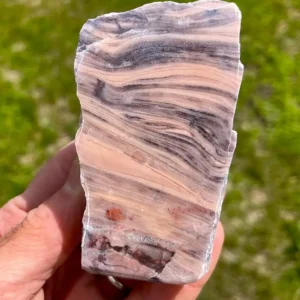
Kona Dolomite (KONA33)
Notes specific to this specimen: We cut and polish these particular Kona Dolomite pieces to showcase the uniqueness of this material. Here the front is cut and polished. It sits upright on a flat base with a slight angle for optimal viewing. The back is left rough. This piece has beautiful coloration.Great conversation piece of one of the world’s oldest fossils.
SIZE: 3″ HighNAME: Collenia kona
AGE: Paleoproterozoic Era 2.3 billion years
UNIT: Kona Formation
SITE: Kona Hills, Michigan
DATE: 2025
BY: Jon Kramer & Julie MartinezDocumentation: This authentic fossil specimen comes with a Certificate of Authenticity and Origin. In addition, an attractive and informative display card accompanies the specimen.
$85.00Kona Dolomite (KONA33)
$85.00 -
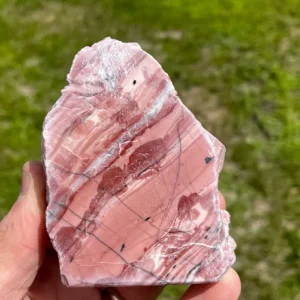
Kona Dolomite (KONA32)
Notes specific to this specimen: We cut and polish these particular Kona Dolomite pieces to showcase the uniqueness of this material. Here the front is cut and polished. It sits upright on a flat base with a slight angle for optimal viewing. The back is left rough. This piece has beautiful coloration.Great conversation piece of one of the world’s oldest fossils.
SIZE: 3″ HighNAME: Collenia kona
AGE: Paleoproterozoic Era 2.3 billion years
UNIT: Kona Formation
SITE: Kona Hills, Michigan
DATE: 2025
BY: Jon Kramer & Julie MartinezDocumentation: This authentic fossil specimen comes with a Certificate of Authenticity and Origin. In addition, an attractive and informative display card accompanies the specimen.
$65.00Kona Dolomite (KONA32)
$65.00 -
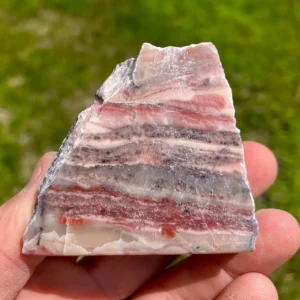
Kona Dolomite (KONA31)
Notes specific to this specimen: We cut and polish these particular Kona Dolomite pieces to showcase the uniqueness of this material. Here the front is cut and polished. It sits upright on a flat base with a slight angle for optimal viewing. The back is left rough. This piece shows nice stromatolitic banding. There is some slight marring in the finish at the top. Great conversation piece of one of the world’s oldest fossils.
SIZE: 2″ High
NAME: Collenia kona
AGE: Paleoproterozoic Era 2.3 billion years
UNIT: Kona Formation
SITE: Kona Hills, Michigan
DATE: 2025
BY: Jon Kramer & Julie MartinezDocumentation: This authentic fossil specimen comes with a Certificate of Authenticity and Origin. In addition, an attractive and informative display card accompanies the specimen.
$35.00Kona Dolomite (KONA31)
$35.00 -
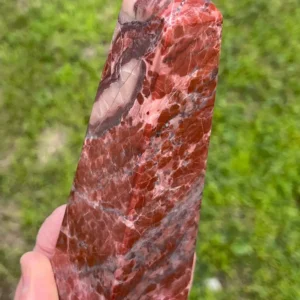
Kona Dolomite (KONA28)
Notes specific to this specimen: Some Kona Dolomite we have carved into various shapes to accentuate the colors and patterns. This obelisk shows lively color and great patterning that is present in the better pieces of this unique material. Polished on all sides, with a flat base so it stands up easily.
SIZE: 6″
NAME: Collenia kona
AGE: Paleoproterozoic Era 2.3 billion years
UNIT: Kona Formation
SITE: Kona Hills, Michigan
DATE: 2025
BY: Jon Kramer & Julie MartinezDocumentation: This authentic fossil specimen comes with a Certificate of Authenticity and Origin. In addition, an attractive and informative display card accompanies the specimen.
$130.00Kona Dolomite (KONA28)
$130.00 -
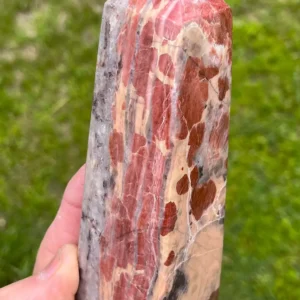
Kona Dolomite (KONA27)
Notes specific to this specimen: Some Kona Dolomite we have carved into various shapes to accentuate the colors and patterns. This obelisk shows lively color and great patterning that is present in the better pieces of this unique material. Polished on all sides, with a flat base so it stands up easily.
SIZE: 5″
NAME: Collenia kona
AGE: Paleoproterozoic Era 2.3 billion years
UNIT: Kona Formation
SITE: Kona Hills, Michigan
DATE: 2025
BY: Jon Kramer & Julie MartinezDocumentation: This authentic fossil specimen comes with a Certificate of Authenticity and Origin. In addition, an attractive and informative display card accompanies the specimen.
$110.00Kona Dolomite (KONA27)
$110.00 -
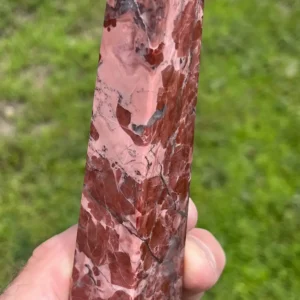
Kona Dolomite (KONA26)
Notes specific to this specimen: Some Kona Dolomite we have carved into various shapes to accentuate the colors and patterns. This obelisk shows lively color and great patterning that is present in the better pieces of this unique material. Polished on all sides, with a flat base so it stands up easily.
SIZE: 5″
NAME: Collenia kona
AGE: Paleoproterozoic Era 2.3 billion years
UNIT: Kona Formation
SITE: Kona Hills, Michigan
DATE: 2025
BY: Jon Kramer & Julie MartinezDocumentation: This authentic fossil specimen comes with a Certificate of Authenticity and Origin. In addition, an attractive and informative display card accompanies the specimen.
$110.00Kona Dolomite (KONA26)
$110.00 -
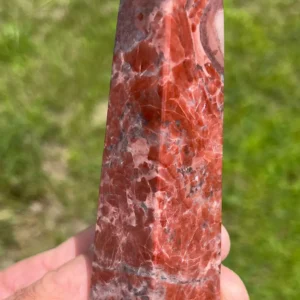
Kona Dolomite (KONA25)
Notes specific to this specimen: Some Kona Dolomite we have carved into various shapes to accentuate the colors and patterns. This obelisk shows lively color and great patterning that is present in the better pieces of this unique material. Polished on all sides, with a flat base so it stands up easily.
SIZE: 4.5″
NAME: Collenia kona
AGE: Paleoproterozoic Era 2.3 billion years
UNIT: Kona Formation
SITE: Kona Hills, Michigan
DATE: 2025
BY: Jon Kramer & Julie MartinezDocumentation: This authentic fossil specimen comes with a Certificate of Authenticity and Origin. In addition, an attractive and informative display card accompanies the specimen.
$95.00Kona Dolomite (KONA25)
$95.00 -
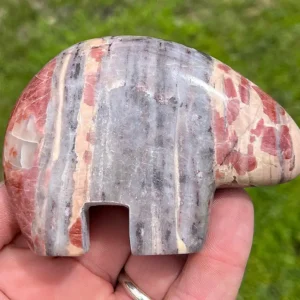
Kona Dolomite (KONA24)
Notes specific to this specimen: Some Kona Dolomite we have carved into various shapes to accentuate the colors and patterns. This is a traditional Zuni pueblo fetish bear shape with nice banding showing the stromatolite layering. Polished on both sides, with a flat base so it stands up easily.
SIZE: 4″
NAME: Collenia kona
AGE: Paleoproterozoic Era 2.3 billion years
UNIT: Kona Formation
SITE: Kona Hills, Michigan
DATE: 2025
BY: Jon Kramer & Julie MartinezDocumentation: This authentic fossil specimen comes with a Certificate of Authenticity and Origin. In addition, an attractive and informative display card accompanies the specimen.
$85.00Kona Dolomite (KONA24)
$85.00 -
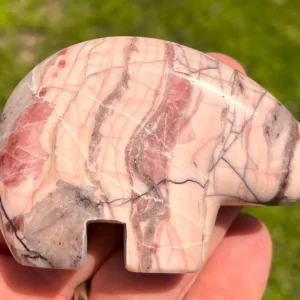
Kona Dolomite (KONA23)
Notes specific to this specimen: Some Kona Dolomite we have carved into various shapes to accentuate the colors and patterns. This is a traditional Zuni pueblo fetish bear shape with nice banding showing the stromatolite layering. Polished on both sides, with a flat base so it stands up easily.
SIZE: 3.5″
NAME: Collenia kona
AGE: Paleoproterozoic Era 2.3 billion years
UNIT: Kona Formation
SITE: Kona Hills, Michigan
DATE: 2025
BY: Jon Kramer & Julie MartinezDocumentation: This authentic fossil specimen comes with a Certificate of Authenticity and Origin. In addition, an attractive and informative display card accompanies the specimen.
$85.00Kona Dolomite (KONA23)
$85.00 -
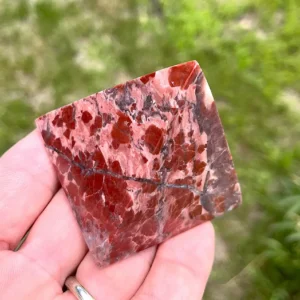
Kona Dolomite (KONA22)
Notes specific to this specimen: Some Kona Dolomite we have carved into various shapes to accentuate the colors and patterns. Classic pyramid shape with nice deep red iron oxide coloration. Polished all the way around – on all sides and base.
SIZE: 2.75″
NAME: Collenia kona
AGE: Paleoproterozoic Era 2.3 billion years
UNIT: Kona Formation
SITE: Kona Hills, Michigan
DATE: 2025
BY: Jon Kramer & Julie MartinezDocumentation: This authentic fossil specimen comes with a Certificate of Authenticity and Origin. In addition, an attractive and informative display card accompanies the specimen.
$112.00Kona Dolomite (KONA22)
$112.00 -
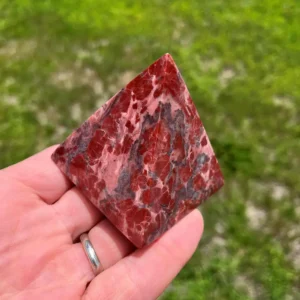
Kona Dolomite (KONA21)
Notes specific to this specimen: Some Kona Dolomite we have carved into various shapes to accentuate the colors and patterns. Classic pyramid shape with nice deep red iron oxide coloration. Polished all the way around – on all sides and base.
SIZE: 2.75″
NAME: Collenia kona
AGE: Paleoproterozoic Era 2.3 billion years
UNIT: Kona Formation
SITE: Kona Hills, Michigan
DATE: 2025
BY: Jon Kramer & Julie MartinezDocumentation: This authentic fossil specimen comes with a Certificate of Authenticity and Origin. In addition, an attractive and informative display card accompanies the specimen.
$112.00Kona Dolomite (KONA21)
$112.00 -
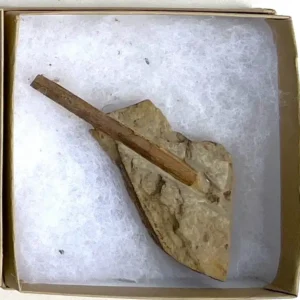
Dinosaur Bone (D35)
Notes specific to this specimen: We learn a lot of stuff from studying the animals and plants of the past. Here’s a great example – It’s a little-known fact that bipedal dinosaurs were far more well-adapted to walking upright than humans have ever been. Modern medicine does, in fact, utilize this important attribute: When the time comes to stabilize someone’s back injury, doctors sometimes attach reinforcement rods to the vertebrae in the injured area and fuse it together with the bone. This exact type of reinforcement is something dinosaurs had already developed 200 million years ago!
At our site in Wyoming we excavated mostly the bones of Edmontosaurus, a bipedal ornithischian dinosaur from the late Cretaceous. In the bonebed we found lots of backbones and, with them, hundreds of pieces of ossified tendon which Edmontosaurus had crisscrossing their vertebrae. These tendons strengthened and reinforced the skeleton, stabilizing their backbone especially in the area of the pelvis. Here we are offering genuine pieces of ossified tendon – mounted on the very matrix we dug it out of – dug directly out of our site in Wyoming. It’s a piece of human history and ancient natural history as well.
SIZE: (box) 3″ x 3″
NAME: Edmontosaurus
AGE: Cretaceous Period – 68 million years
UNIT: Lance Creek Formation
SITE: Lance Creek, WyomingDATE: Early 1990’s
Documentation: This authentic fossil specimen comes with a Certificate of Authenticity and Origin.
$85.00Dinosaur Bone (D35)
$85.00