
Grypania
-
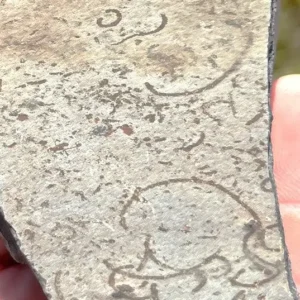
Grypania Spiralis (GRY12)
Notes specific to this specimen: An absolute stellar specimen! There were only a few specimens recovered that showed such abundance and contrast. This particular horizon we called “Grypania Heaven” due to its stellar appearance. This super-rich slab is populated with dozens of showy and very distinct Grypania, many with characteristic curvature and arcs. In addition, some of the specimens have desiccation distortion along the sheath
SIZE: 3″ x 5″
NAME: Grypania spiralis
AGE: Paleoproterozoic Era / 2.1 billion years
UNIT: Negaunee Iron Formation
SITE: Empire Mine, Palmer, Michigan$12,500.00Grypania Spiralis (GRY12)
$12,500.00 -
Grypania Spiralis (GRY2)
Notes specific to this specimen: Nice cabinet specimen showing several nice segments of Grypania with the classic curving arc formed by this species. Some segments show great examples of what’s been described as “desiccation” of the outer sheath along its length. This results in impingement of the sheath between individual cells, giving it a “bumpy” appearance. The desiccated segments are very rare.
SIZE: 4″ x 5″ x 0.75″
NAME: Grypania spiralis
AGE: Paleoproterozoic Era / 2.1 billion years
UNIT: Negaunee Iron Formation
SITE: Empire Mine, Palmer, Michigan$6,500.00Grypania Spiralis (GRY2)
$6,500.00 -
Grypania Spiralis (GRY11)
Notes specific to this specimen: Nice hand-sized slab with several showy and very distinct Grypania strings, some of which have characteristic curvature and arcs. In addition, some of the specimens have desiccation distortion along the sheath.
SIZE: 5″ x 6″
NAME: Grypania spiralis
AGE: Paleoproterozoic Era / 2.1 billion years
UNIT : Negaunee Iron Formation
SITE: Empire Mine, Palmer, Michigan$2,800.00Grypania Spiralis (GRY11)
$2,800.00 -
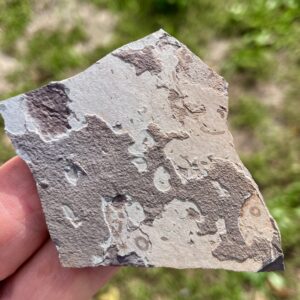
Grypania Spiralis (GRY9)
Notes specific to this specimen: Nice slab showing several clear segments of Grypania, a couple with the classic full circles and others with curving arc formed by this species. A couple of the segments – like the circle in the lower middle – show examples of what’s been described as “desiccation” of the outer sheath along its length. This results in impingement of the sheath between individual cells, giving it a “bumpy” appearance. The desiccated segments are very rare.
SIZE: 3″ x 3″
NAME: Grypania spiralis
AGE: Paleoproterozoic Era / 2.1 billion years
UNIT: Negaunee Iron Formation
SITE: Empire Mine, Palmer, Michigan$2,600.00Grypania Spiralis (GRY9)
$2,600.00 -
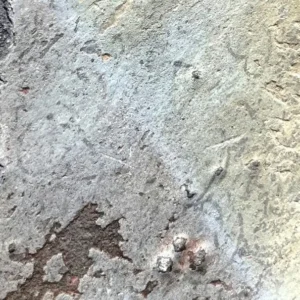
Grypania Spiralis (GRY10)
Notes specific to this specimen: This sizeable slab shows abundant evidence of fragmentary Grypania, although there are some longer pieces with the telltale arching strings. The impressions are numerous but not very apparent except under close inspection.
SIZE: 4″ x 6″
NAME: Grypania spiralis
AGE: Paleoproterozoic Era / 2.1 billion years
UNIT : Negaunee Iron Formation
SITE: Empire Mine, Palmer, Michigan$1,850.00Grypania Spiralis (GRY10)
$1,850.00 -
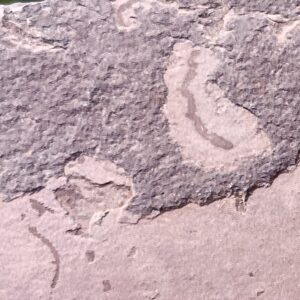
Grypania Spiralis (GRY7)
Notes specific to this specimen: This piece shows clear segments of Grypania, a couple with the classic curving arc formed by this species. The most notable, however, is the clear “squiggly” segment in the top left. It is a perfect example of what’s been described as “desiccation” of the outer sheath along its length, resulting in impingement of the sheath between individual cells. It doesn’t get any more graphic than this!
SIZE: 2″ x 3″
NAME: Grypania spiralis
AGE: Paleoproterozoic Era / 2.1 billion years
UNIT: Negaunee Iron Formation
SITE: Empire Mine, Palmer, Michigan$1,800.00Grypania Spiralis (GRY7)
$1,800.00 -
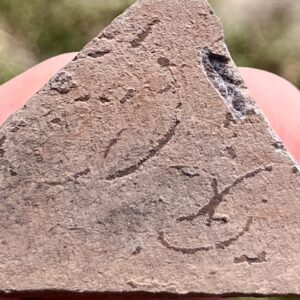
Grypania Spiralis (GRY8)
Notes specific to this specimen: Nice slab showing several clear segments of Grypania, a couple with the classic full circles and others with curving arc formed by this species. A couple of the segments – like the circle in the lower middle – show examples of what’s been described as “desiccation” of the outer sheath along its length. This results in impingement of the sheath between individual cells, giving it a “bumpy” appearance. The desiccated segments are very rare.
SIZE: 1.5″ x 2″
NAME: Grypania spiralis
AGE: Paleoproterozoic Era / 2.1 billion years
UNIT: Negaunee Iron Formation
SITE: Empire Mine, Palmer, Michigan$950.00Grypania Spiralis (GRY8)
$950.00
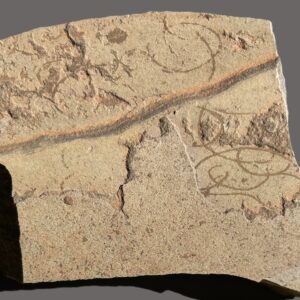
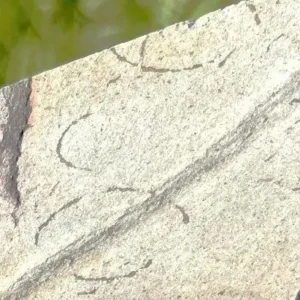
NAME: Grypania spiralis
AGE: Paleoproterozoic Era 2.1 billion years
UNIT : Negaunee Iron Formation
SITE: Empire Mine, Palmer, Michigan
THE STORY
These are specimens of 2.1 billion-year-old Grypania spiralis – the oldest known eukaryotic organism (cells with a nucleus) and one of the rarest fossils on Earth. They have been interpreted as strings of red algae cells encased in a membranous sheath and are from the middle Precambrian (2.2 billion years) Negaunee Iron formation in upper Michigan.
Grypania spiralis is by far the oldest known complex organism. All other specimens of this age are prokaryotes (simple, single-celled organisms that lack a cellular nucleus – such as stromatolites). This organism represents a foundational evolutionary milestone—proving that structurally complex, visible, multi-celled photosynthetic life was established shortly after the global transition of the Great Oxidation Event. Discovery of Grypania in Precambrian iron deposits caused great excitement in the world of paleontology because these organisms are over 1 billion years older than the next-closest-aged eukaryote.
These fossils manifest as distinct, unbranched, ribbon-like sheaths with accompanying cells structurally bound in arcs and partial coils. The strong curvature combined with the sometimes “bumpy” appearance to the ribbon is consistent with desiccation shrinkage of an outer sheath between consecutive cells along its length. Continuous ribbons of Grypania can reach lengths of upwards of 150 millimetres, a scale that excludes simple, single-celled prokaryotic architecture.
These specimens are permanently stable, preserved as dark carbonaceous films compressed into a finely-laminated, grey to brown iron-rich silicate, the slate-like end phase of a locally metamorphosed mudstone. Some specimens from the locality contain preserved ripple marks in conjunction with Grypania indicating a very shallow subaqueous depositional environment, possibly a tidal flat. They are preserved in the exact benchmark laminar beds made famous by the pioneering discoveries of Tsu-Ming Han in 1992.
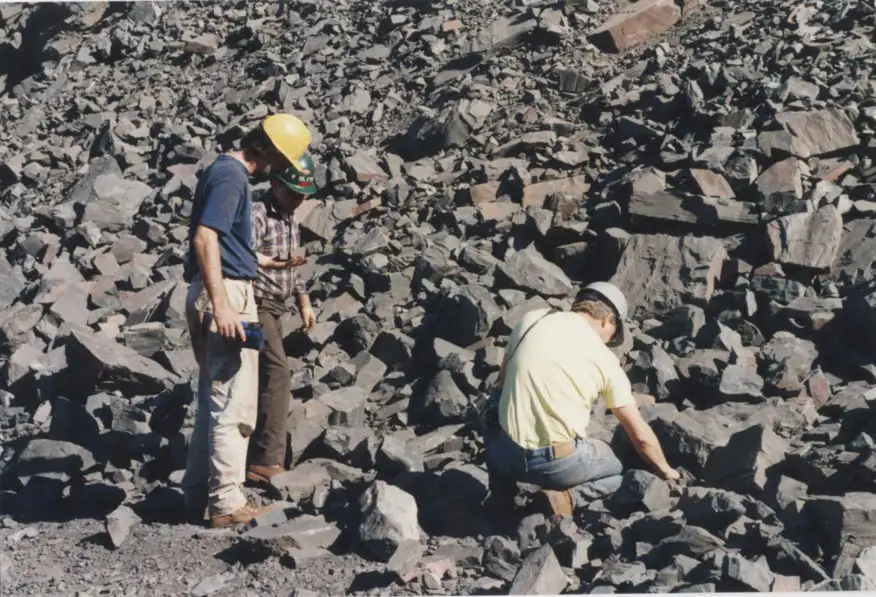
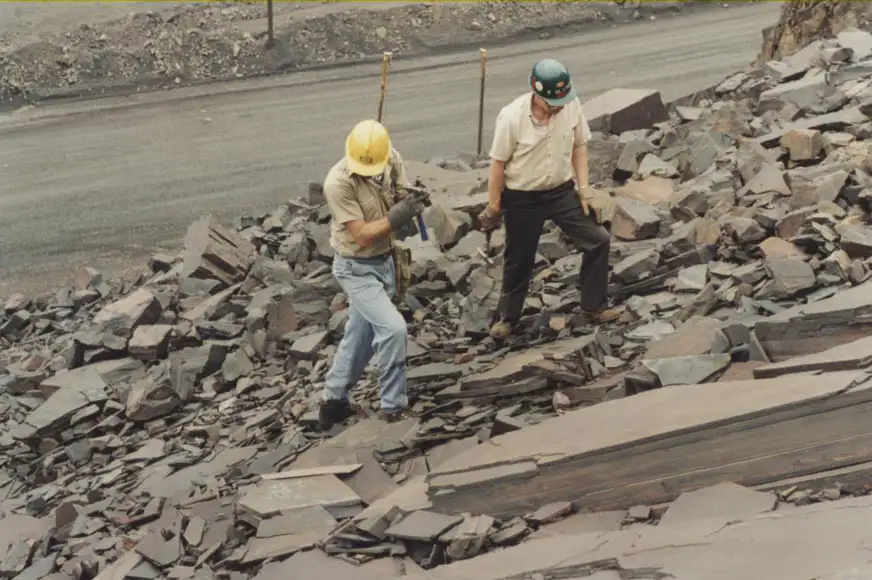
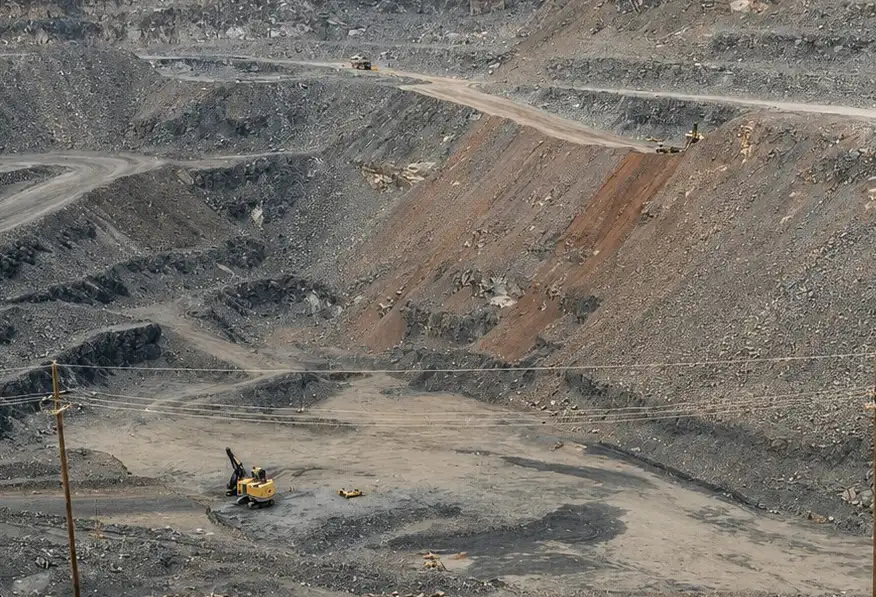
Potomac Museum Group (PMG) – precursor of Pacific GeoLab – collected these rare specimens in the early 1990’s as a paleontological rescue operation. They are known from only one small location in the now-defunct Empire Mine near Palmer, Michigan. The site was lost to mining activity shortly after we made our last trip there in 1994. Almost all of the collected specimens – several dozen – were donated to museums and institutions around the world. The few specimens offered here were never accessioned into the PMG collections and became the property of Jon Kramer when PMG was dissolved.
References: See Grypania pdf in our RESEARCH / References section