
-
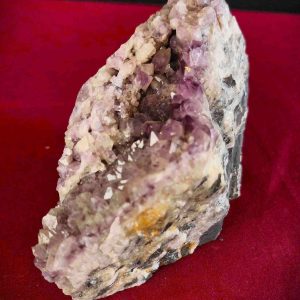
Cerdito Prospect Rift Crystals (CP14)
Notes specific to this specimen: Cool combination of nice light smokey quartz crystals and deep amethyst crystals in the same vein. Nice healed fracturing evident on the edge. This piece has a cut-flat bottom so it stands up and displays very nicely. Take a look at the cut bottom and you’ll see the very graphic splitting of the matrix and the subsequent infilling with white quartz and citrine.
SIZE: 6″ x 3″ x 4″
Quartz – Amethyst, Smokey, Citrine, Clear
AGE: Mesoproterozoic Era – 1.1 billion years
UNIT: Rove Formation
SITE: Thunder Bay, Ontario, Canada
DATE: 2022Documentation: This authentic mineral specimen comes with a Certificate of Authenticity and Origin.
$385.00 -
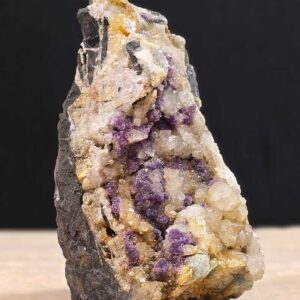
Cerdito Prospect Rift Crystals (CP2)
Notes specific to this specimen: Incredible combination of small clear quartz crystals with purple fluorite crystals over top of botryoidal green fluorite. Nice standup piece has sawn-flat bottom and back showing the dynamic cracks and infilling produced by the North American Midcontinent Rift which happened about 1.1 billion years ago. Because of the fluorite, it fluoresces very strong purple/blue.
Documentation: This authentic mineral specimen comes with a Certificate of Authenticity and Origin.
$525.00 -
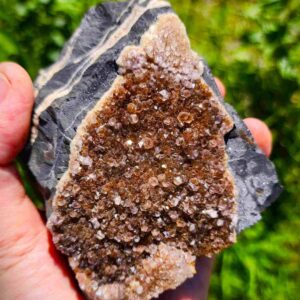
Cerdito Prospect Rift Crystals (CP7)
Notes specific to this specimen: Face has a coating of really nice smokey quartz crystals with some isolated clear and amethyst mixed in. Beautiful healed fracture infills showing on both sides. Also has a nice amethyst-lined hollow on the back with associated smokey quartz. This piece has a cut-flat bottom so it stands up and displays very nicely. Take a look at the cut bottom and you’ll see the very graphic splitting of the matrix and the subsequent infilling. This is a fantastic piece!
SIZE: 3″ x 3″ x 4″
Quartz – Amethyst, Smokey, Citrine, Clear
AGE: Mesoproterozoic Era – 1.1 billion years
UNIT: Rove Formation
SITE: Thunder Bay, Ontario, Canada
DATE: 2022Documentation: This authentic mineral specimen comes with a Certificate of Authenticity and Origin.
$625.00 -
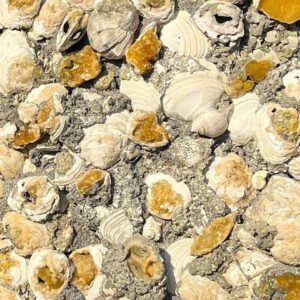
Crystal Clam Wall (OKW7)
Notes specific to this specimen: One of a kind unbelievable specimen! This was dug out in 2023 as several pieces that have been reconstructed into a continuous matrix piece with breathtaking beauty. This is the largest crystal clam matrix specimen in the world. There are over 50 crystalized fossil clams, two crystalized conchs, along with scallops, olive shells, welks, corals and hundreds of other fossil shells in this magnificent museum piece.
HOW THEY FORMED
The area around Lake Okeechobee, Florida was a shallow sea about 2 million years ago. These clams lived in the sandy mud near the shoreline at the time. Sudden storm events – such as hurricanes and tropical storms – periodically buried the area under deep sediments, trapping the clams and other shellfish that lived there. As their bodies decayed, the process left behind cavities in the shells. With the heat and pressure that accompanied the pile-up of sediments, the original shell material (aragonite) became unstable and began to dissolve away. As it happened this provided the elements necessary to grow pure calcite crystals in the open spaces within some of the shells. It has a sturdy backing of plywood with an aluminum frame allowing this piece to be hung either vertically or horizontally. It’s currently on display at 1889 Studios, in the Uptown Rapid (formerly Rushmore Mall) complex in Rapid City, SD. Contact us for shipping options.SIZE: 3′ x 6′ x 10″
NAME: Mercenaria permagna
AGE: Plio-Pleistocene – 2 million years
UNIT: Nashua Formation
SITE: Okeechobee County, Florida
DATE: 2023Documentation: This authentic fossil specimen comes with a Certificate of Authenticity and Origin. In addition, an informative display card accompanies the specimen
$12,500.00Crystal Clam Wall (OKW7)
$12,500.00 -
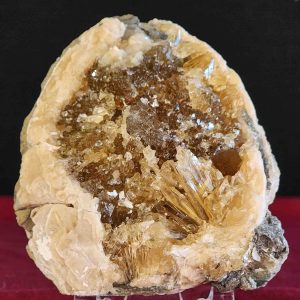
Crystalized Clam (OK1)
Notes specific to this specimen: This complete clam is packed full with honey calcite. There are some fantastic radial calcite crystals amidst a solid honey calcite matrix. The back is a partially recrystallized shell. This is a singularly unique find.
SIZE: 5″x 3″x 2″
NAME: Mercenaria permagna
AGE: Pleistocene 2 million years
UNIT: Nashua Formation
SITE: Okeechobee County, FloridaDocumentation: This authentic fossil specimen comes with a Certificate of Authenticity and Origin. In addition, an attractive and informative display card accompanies the specimen.
$440.00Crystalized Clam (OK1)
$440.00 -
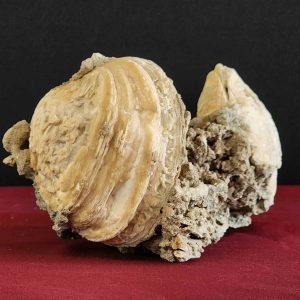
Crystalized Clam (OK10)
Crystalized fossil clams like this are exceptionally rare. These clams lived in a shallow sea that covered most of Florida 2 million years ago. A sudden storm event buried the clams, trapping cavities inside. When the shells began to dissolve, it provided the material necessary to grow calcite crystals in the open spaces. These unusual fossils are known from only one site, an old quarry near Lake Okeechobee. The quarry played out and flooded in 2007. We excavated this in 2023. An attractive and informative display card accompanies the specimen.
Notes specific to this specimen: Two excellent full clams trapped in matrix. Both are recrystallized calcite replaced with clear zones evident. NOTE: These clams do not have any of the honey calcite crystals. But they sure are very cool!
SIZE: 10″x 5″x 4″
NAME: Mercenaria permagna
AGE: Pleistocene 2 million years
UNIT: Nashua Formation
SITE: Okeechobee County, FloridaDocumentation: This authentic fossil specimen comes with a Certificate of Authenticity and Origin. In addition, an attractive and informative display card accompanies the specimen.
$265.00Crystalized Clam (OK10)
$265.00 -
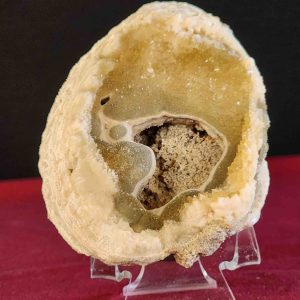
Crystalized Clam (OK2)
Notes specific to this specimen: A complete clam with druzy honey calcite crystals exposed on the front and a recrystallized shell on back. A very unique specimen.
SIZE: 4″x 3″x 2″
NAME: Mercenaria permagna
AGE: Pleistocene 2 million years
UNIT: Nashua Formation
SITE: Okeechobee County, FloridaDocumentation: This authentic fossil specimen comes with a Certificate of Authenticity and Origin. In addition, an attractive and informative display card accompanies the specimen.
$490.00Crystalized Clam (OK2)
$490.00 -
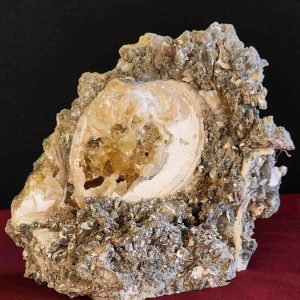
Crystalized Clam (OK3)
Notes specific to this specimen: Great honey calcite crystals replacing the clam shell trapped in matrix. This piece has a sawn flat bottom so it stands up nicely on its own. Nice display specimen
SIZE: 8″x 5″x 5″
NAME: Mercenaria permagna
AGE: Pleistocene 2 million years
UNIT: Nashua Formation
SITE: Okeechobee County, FloridaDocumentation: This authentic fossil specimen comes with a Certificate of Authenticity and Origin. In addition, an attractive and informative display card accompanies the specimen.
$425.00Crystalized Clam (OK3)
$425.00 -
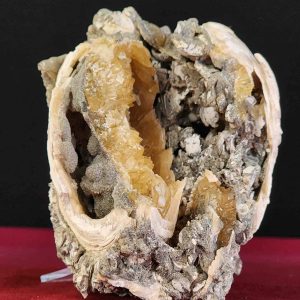
Crystalized Clam (OK4)
Notes specific to this specimen: There are two clams here in this piece of matrix – one inside the other – creating a double hollow with great dogtooth calcite crystals replacing the inner clamshell and some crystals in the outer one as well. A unique and rare find.
SIZE: 6″x 4″x 5″
NAME: Mercenaria permagna
AGE: Pleistocene 2 million years
UNIT: Nashua Formation
SITE: Okeechobee County, FloridaDocumentation: This authentic fossil specimen comes with a Certificate of Authenticity and Origin. In addition, an attractive and informative display card accompanies the specimen.
$845.00Crystalized Clam (OK4)
$845.00 -
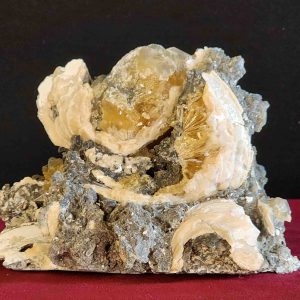
Crystalized Clam (OK5)
Notes specific to this specimen: Great honey calcite crystals replacing multiple clam shells trapped in matrix. Some excellent radial calcite crystals here! This piece has a sawn flat bottom so it stands up nicely on its own.
SIZE: 7″x 5″x 5″NAME: Mercenaria permagna
AGE: Pleistocene 2 million years
UNIT: Nashua Formation
SITE: Okeechobee County, FloridaDocumentation: This authentic fossil specimen comes with a Certificate of Authenticity and Origin. In addition, an attractive and informative display card accompanies the specimen.
$550.00Crystalized Clam (OK5)
$550.00 -
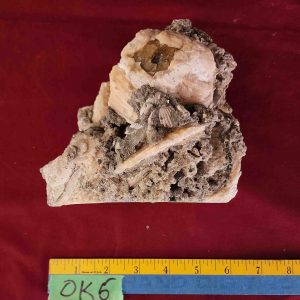
Crystalized Clam (OK6)
Crystalized fossil clams like this are exceptionally rare. These clams lived in a shallow sea that covered most of Florida 2 million years ago. A sudden storm event buried the clams, trapping cavities inside. When the shells began to dissolve, it provided the material necessary to grow calcite crystals in the open spaces. These unusual fossils are known from only one site, an old quarry near Lake Okeechobee. The quarry played out and flooded in 2007. We excavated this in 2023. An attractive and informative display card accompanies the specimen.
Notes specific to this specimen: Great honey calcite crystals replacing multiple clam shells trapped in matrix. This piece has a sawn flat bottom so it stands up nicely on its own
SIZE: 7″x 4″x 5″
NAME: Mercenaria permagna
AGE: Pleistocene 2 million years
UNIT: Nashua Formation
SITE: Okeechobee County, FloridaDocumentation: This authentic fossil specimen comes with a Certificate of Authenticity and Origin. In addition, an attractive and informative display card accompanies the specimen.
$410.00Crystalized Clam (OK6)
$410.00 -
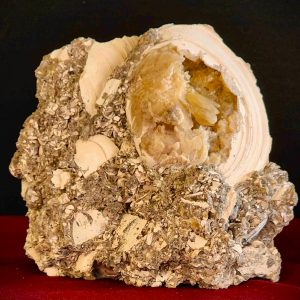
Crystalized Clam (OK7)
Notes specific to this specimen: Great honey calcite crystals replacing one clam shell trapped in matrix. Some excellent radial calcite crystals are on this piece as well.
SIZE: 7″x 5″x 7″NAME: Mercenaria permagna
AGE: Pleistocene 2 million years
UNIT: Nashua Formation
SITE: Okeechobee County, FloridaDocumentation: This authentic fossil specimen comes with a Certificate of Authenticity and Origin. In addition, an attractive and informative display card accompanies the specimen.
$310.00Crystalized Clam (OK7)
$310.00
Shop Our Catalog
- Browse All Products
- Agatized Algae
- Agatized Coral
- Banded Iron Formation
- Cerdito Prospect Rift Crystals
- Rucks Pit
- Dinosaur Bones
- Exceptional Museum Specimens
- Fossil Crabs
- Fossil Echinoids
- Fossil Fern
- Fossil Fish
- Gunflint Chert
- Grypania Spiralis
- Gypsum Selenite
- Biwabik Iron Stromatolites
- Kettleman Hills Fossils
- Kona Dolomite
- Rucks Pit
- Specularite
- Sudbury Impactite
- Trilobites
- Volcanic Bombs