
All Products
-
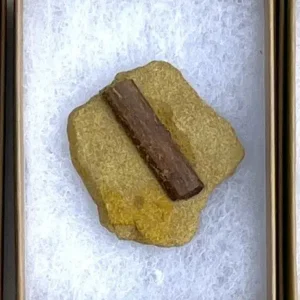
Dinosaur Bone (D23)
Notes specific to this specimen: We learn a lot of stuff from studying the animals and plants of the past. Here’s a great example – It’s a little-known fact that bipedal dinosaurs were far more well-adapted to walking upright than humans have ever been. Modern medicine does, in fact, utilize this important attribute: When the time comes to stabilize someone’s back injury, doctors sometimes attach reinforcement rods to the vertebrae in the injured area and fuse it together with the bone. This exact type of reinforcement is something dinosaurs had already developed 200 million years ago!
At our site in Wyoming we excavated mostly the bones of Edmontosaurus, a bipedal ornithischian dinosaur from the late Cretaceous. In the bonebed we found lots of backbones and, with them, hundreds of pieces of ossified tendon which Edmontosaurus had crisscrossing their vertebrae. These tendons strengthened and reinforced the skeleton, stabilizing their backbone especially in the area of the pelvis. Here we are offering genuine pieces of ossified tendon – mounted on the very matrix we dug it out of – dug directly out of our site in Wyoming. It’s a piece of human history and ancient natural history as well.
SIZE: (box) 2″ x 3″
NAME: Edmontosaurus
AGE: Cretaceous Period – 68 million years
UNIT: Lance Creek Formation
SITE: Lance Creek, WyomingDATE: Early 1990’s
Documentation: This authentic fossil specimen comes with a Certificate of Authenticity and Origin.
$65.00Dinosaur Bone (D23)
$65.00 -
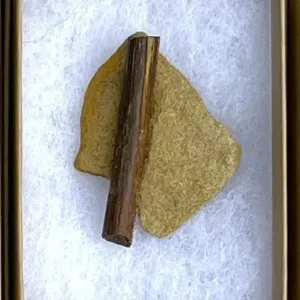
Dinosaur Bone (D24)
Notes specific to this specimen: We learn a lot of stuff from studying the animals and plants of the past. Here’s a great example – It’s a little-known fact that bipedal dinosaurs were far more well-adapted to walking upright than humans have ever been. Modern medicine does, in fact, utilize this important attribute: When the time comes to stabilize someone’s back injury, doctors sometimes attach reinforcement rods to the vertebrae in the injured area and fuse it together with the bone. This exact type of reinforcement is something dinosaurs had already developed 200 million years ago!
At our site in Wyoming we excavated mostly the bones of Edmontosaurus, a bipedal ornithischian dinosaur from the late Cretaceous. In the bonebed we found lots of backbones and, with them, hundreds of pieces of ossified tendon which Edmontosaurus had crisscrossing their vertebrae. These tendons strengthened and reinforced the skeleton, stabilizing their backbone especially in the area of the pelvis. Here we are offering genuine pieces of ossified tendon – mounted on the very matrix we dug it out of – dug directly out of our site in Wyoming. It’s a piece of human history and ancient natural history as well.
SIZE: (box) 2″ x 3″
NAME: Edmontosaurus
AGE: Cretaceous Period – 68 million years
UNIT: Lance Creek Formation
SITE: Lance Creek, WyomingDATE: Early 1990’s
Documentation: This authentic fossil specimen comes with a Certificate of Authenticity and Origin.
$65.00Dinosaur Bone (D24)
$65.00 -
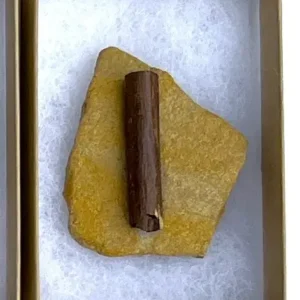
Dinosaur Bone (D25)
Notes specific to this specimen: We learn a lot of stuff from studying the animals and plants of the past. Here’s a great example – It’s a little-known fact that bipedal dinosaurs were far more well-adapted to walking upright than humans have ever been. Modern medicine does, in fact, utilize this important attribute: When the time comes to stabilize someone’s back injury, doctors sometimes attach reinforcement rods to the vertebrae in the injured area and fuse it together with the bone. This exact type of reinforcement is something dinosaurs had already developed 200 million years ago!
At our site in Wyoming we excavated mostly the bones of Edmontosaurus, a bipedal ornithischian dinosaur from the late Cretaceous. In the bonebed we found lots of backbones and, with them, hundreds of pieces of ossified tendon which Edmontosaurus had crisscrossing their vertebrae. These tendons strengthened and reinforced the skeleton, stabilizing their backbone especially in the area of the pelvis. Here we are offering genuine pieces of ossified tendon – mounted on the very matrix we dug it out of – dug directly out of our site in Wyoming. It’s a piece of human history and ancient natural history as well.
SIZE: (box) 2″ x 3″
NAME: Edmontosaurus
AGE: Cretaceous Period – 68 million years
UNIT: Lance Creek Formation
SITE: Lance Creek, WyomingDATE: Early 1990’s
Documentation: This authentic fossil specimen comes with a Certificate of Authenticity and Origin.
$65.00Dinosaur Bone (D25)
$65.00 -
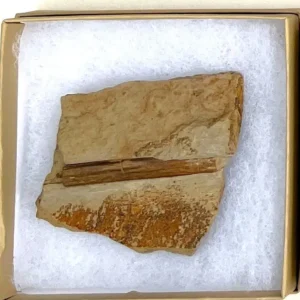
Dinosaur Bone (D31)
Notes specific to this specimen: We learn a lot of stuff from studying the animals and plants of the past. Here’s a great example – It’s a little-known fact that bipedal dinosaurs were far more well-adapted to walking upright than humans have ever been. Modern medicine does, in fact, utilize this important attribute: When the time comes to stabilize someone’s back injury, doctors sometimes attach reinforcement rods to the vertebrae in the injured area and fuse it together with the bone. This exact type of reinforcement is something dinosaurs had already developed 200 million years ago!
At our site in Wyoming we excavated mostly the bones of Edmontosaurus, a bipedal ornithischian dinosaur from the late Cretaceous. In the bonebed we found lots of backbones and, with them, hundreds of pieces of ossified tendon which Edmontosaurus had crisscrossing their vertebrae. These tendons strengthened and reinforced the skeleton, stabilizing their backbone especially in the area of the pelvis. Here we are offering genuine pieces of ossified tendon – mounted on the very matrix we dug it out of – dug directly out of our site in Wyoming. It’s a piece of human history and ancient natural history as well.
SIZE: (box) 3″ x 3″
NAME: Edmontosaurus
AGE: Cretaceous Period – 68 million years
UNIT: Lance Creek Formation
SITE: Lance Creek, WyomingDATE: Early 1990’s
Documentation: This authentic fossil specimen comes with a Certificate of Authenticity and Origin.
$85.00Dinosaur Bone (D31)
$85.00 -
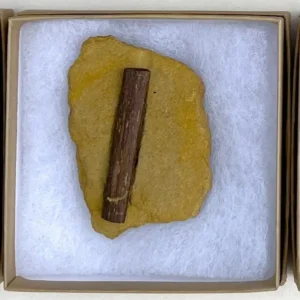
Dinosaur Bone (D32)
Notes specific to this specimen: We learn a lot of stuff from studying the animals and plants of the past. Here’s a great example – It’s a little-known fact that bipedal dinosaurs were far more well-adapted to walking upright than humans have ever been. Modern medicine does, in fact, utilize this important attribute: When the time comes to stabilize someone’s back injury, doctors sometimes attach reinforcement rods to the vertebrae in the injured area and fuse it together with the bone. This exact type of reinforcement is something dinosaurs had already developed 200 million years ago!
At our site in Wyoming we excavated mostly the bones of Edmontosaurus, a bipedal ornithischian dinosaur from the late Cretaceous. In the bonebed we found lots of backbones and, with them, hundreds of pieces of ossified tendon which Edmontosaurus had crisscrossing their vertebrae. These tendons strengthened and reinforced the skeleton, stabilizing their backbone especially in the area of the pelvis. Here we are offering genuine pieces of ossified tendon – mounted on the very matrix we dug it out of – dug directly out of our site in Wyoming. It’s a piece of human history and ancient natural history as well.
SIZE: (box) 3″ x 3″
NAME: Edmontosaurus
AGE: Cretaceous Period – 68 million years
UNIT: Lance Creek Formation
SITE: Lance Creek, WyomingDATE: Early 1990’s
Documentation: This authentic fossil specimen comes with a Certificate of Authenticity and Origin.
$85.00Dinosaur Bone (D32)
$85.00 -
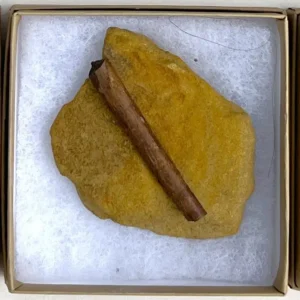
Dinosaur Bone (D33)
Notes specific to this specimen: We learn a lot of stuff from studying the animals and plants of the past. Here’s a great example – It’s a little-known fact that bipedal dinosaurs were far more well-adapted to walking upright than humans have ever been. Modern medicine does, in fact, utilize this important attribute: When the time comes to stabilize someone’s back injury, doctors sometimes attach reinforcement rods to the vertebrae in the injured area and fuse it together with the bone. This exact type of reinforcement is something dinosaurs had already developed 200 million years ago!
At our site in Wyoming we excavated mostly the bones of Edmontosaurus, a bipedal ornithischian dinosaur from the late Cretaceous. In the bonebed we found lots of backbones and, with them, hundreds of pieces of ossified tendon which Edmontosaurus had crisscrossing their vertebrae. These tendons strengthened and reinforced the skeleton, stabilizing their backbone especially in the area of the pelvis. Here we are offering genuine pieces of ossified tendon – mounted on the very matrix we dug it out of – dug directly out of our site in Wyoming. It’s a piece of human history and ancient natural history as well.
SIZE: (box) 3″ x 3″
NAME: Edmontosaurus
AGE: Cretaceous Period – 68 million years
UNIT: Lance Creek Formation
SITE: Lance Creek, WyomingDATE: Early 1990’s
Documentation: This authentic fossil specimen comes with a Certificate of Authenticity and Origin.
$85.00Dinosaur Bone (D33)
$85.00 -
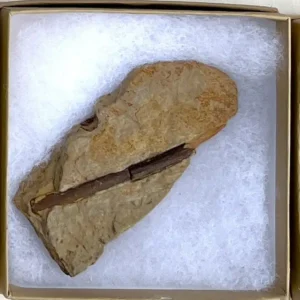
Dinosaur Bone (D34)
Notes specific to this specimen: We learn a lot of stuff from studying the animals and plants of the past. Here’s a great example – It’s a little-known fact that bipedal dinosaurs were far more well-adapted to walking upright than humans have ever been. Modern medicine does, in fact, utilize this important attribute: When the time comes to stabilize someone’s back injury, doctors sometimes attach reinforcement rods to the vertebrae in the injured area and fuse it together with the bone. This exact type of reinforcement is something dinosaurs had already developed 200 million years ago!
At our site in Wyoming we excavated mostly the bones of Edmontosaurus, a bipedal ornithischian dinosaur from the late Cretaceous. In the bonebed we found lots of backbones and, with them, hundreds of pieces of ossified tendon which Edmontosaurus had crisscrossing their vertebrae. These tendons strengthened and reinforced the skeleton, stabilizing their backbone especially in the area of the pelvis. Here we are offering genuine pieces of ossified tendon – mounted on the very matrix we dug it out of – dug directly out of our site in Wyoming. It’s a piece of human history and ancient natural history as well.
SIZE: (box) 3″ x 3″
NAME: Edmontosaurus
AGE: Cretaceous Period – 68 million years
UNIT: Lance Creek Formation
SITE: Lance Creek, WyomingDATE: Early 1990’s
Documentation: This authentic fossil specimen comes with a Certificate of Authenticity and Origin.
$85.00Dinosaur Bone (D34)
$85.00 -
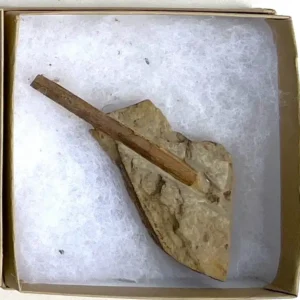
Dinosaur Bone (D35)
Notes specific to this specimen: We learn a lot of stuff from studying the animals and plants of the past. Here’s a great example – It’s a little-known fact that bipedal dinosaurs were far more well-adapted to walking upright than humans have ever been. Modern medicine does, in fact, utilize this important attribute: When the time comes to stabilize someone’s back injury, doctors sometimes attach reinforcement rods to the vertebrae in the injured area and fuse it together with the bone. This exact type of reinforcement is something dinosaurs had already developed 200 million years ago!
At our site in Wyoming we excavated mostly the bones of Edmontosaurus, a bipedal ornithischian dinosaur from the late Cretaceous. In the bonebed we found lots of backbones and, with them, hundreds of pieces of ossified tendon which Edmontosaurus had crisscrossing their vertebrae. These tendons strengthened and reinforced the skeleton, stabilizing their backbone especially in the area of the pelvis. Here we are offering genuine pieces of ossified tendon – mounted on the very matrix we dug it out of – dug directly out of our site in Wyoming. It’s a piece of human history and ancient natural history as well.
SIZE: (box) 3″ x 3″
NAME: Edmontosaurus
AGE: Cretaceous Period – 68 million years
UNIT: Lance Creek Formation
SITE: Lance Creek, WyomingDATE: Early 1990’s
Documentation: This authentic fossil specimen comes with a Certificate of Authenticity and Origin.
$85.00Dinosaur Bone (D35)
$85.00 -
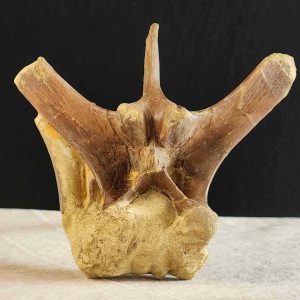
Dinosaur Bones (D1)
Notes specific to this specimen: This is a very well preserved neural arch and process of a cervical vertebrae, probably about midway down the neck of a hadrosaur (bipedal) dinosaur. The centrum is not present. The fine detail on the bone surface is exquisite and remarkably well preserved. This exceptional piece has no reconstruction.
SIZE: 5″ x 5″ x 3″
NAME: Edmontosaurus
AGE: Cretaceous Period – 68 million years
UNIT: Lance Creek Formation
SITE: Lance Creek, WyomingDATE: 1992
Documentation: This authentic fossil specimen comes with a Certificate of Authenticity and Origin.
$820.00Dinosaur Bones (D1)
$820.00 -
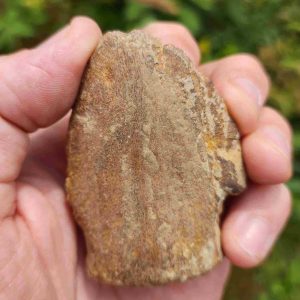
Dinosaur Bones (D2)
Notes specific to this specimen: Commonly called the “hoof” of a hadrosaur – in this case Edmontosaurus – this is the end bone of a pes digit (toe). In vertebrates, the ends of the front appendages are called the “manus” (aka hand) while the back are called the “pes” (aka foot). The asymmetry here indicates this was likely a toe on the right side of the animal. The fine detail on the bone surface is exquisite and remarkably well preserved. This piece has no reconstruction.
SIZE: 3″ x 2″ x 1″
NAME: Edmontosaurus
AGE: Cretaceous Period – 68 million years
UNIT: Lance Creek Formation
SITE: Lance Creek, WyomingDATE: 1992
Documentation: This authentic fossil specimen comes with a Certificate of Authenticity and Origin.
$575.00Dinosaur Bones (D2)
$575.00 -
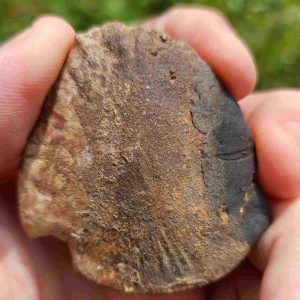
Dinosaur Bones (D3)
Notes specific to this specimen: Commonly called the “hoof” of a hadrosaur – in this case Edmontosaurus – this is the end bone of a pes digit (toe). In vertebrates, the ends of the front appendages are called the “manus” (aka hand) while the back are called the “pes” (aka foot). The fine detail on the bone surface is remarkably well preserved. This piece has a small amount of reconstruction as shown in the dark paleoclay area.
SIZE: 3″ x 2″ x 3″
NAME: Edmontosaurus
AGE: Cretaceous Period – 68 million years
UNIT: Lance Creek Formation
SITE: Lance Creek, WyomingDATE: 1992
Documentation: This authentic fossil specimen comes with a Certificate of Authenticity and Origin.
$420.00Dinosaur Bones (D3)
$420.00 -
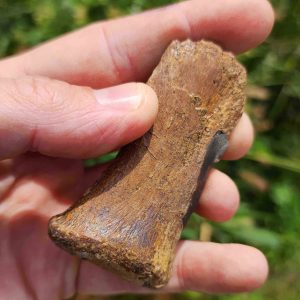
Dinosaur Bones (D4)
Notes specific to this specimen: This is a distal manus digit (“finger”) bone of Edmontosaurus. In vertebrates, the ends of the front appendages are called the “manus” (aka hand) while the back are called the “pes” (aka foot). The fine detail on the bone surface is remarkably well preserved. This piece has a small amount of reconstruction as shown in the dark paleoclay area.
SIZE: 3″ x 1″ x 1″
NAME: Edmontosaurus
AGE: Cretaceous Period – 68 million years
UNIT: Lance Creek Formation
SITE: Lance Creek, WyomingDATE: 1992
Documentation: This authentic fossil specimen comes with a Certificate of Authenticity and Origin.
$365.00Dinosaur Bones (D4)
$365.00