All Products
-
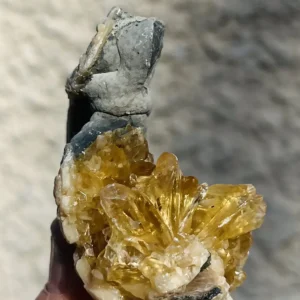
Crystalized Clam (OK14)
Notes specific to this specimen: Exceptional museum grade specimen. Classic full size clam loaded with juicy calcite crystals. No repairs, no touch up, no enhancements – just pure crystal joy. Full clam in matrix. Sits upright.
SIZE: 2″x 1.5″x 1″
Name / Species: Mercenaria permagna
Age: Pleistocene 2 - 4 Million Years
Unit: Nashua Formation
Site: Okeechobee County, Florida
Collected: 2026
Collected by: Jon KramerDocumentation: This authentic fossil specimen comes with a Certificate of Authenticity and Origin.
$75.00Crystalized Clam (OK14)
$75.00 -
Crystalized Clam (OK2)
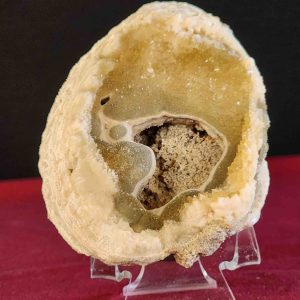
Notes specific to this specimen: A complete clam with druzy honey calcite crystals exposed on the front and a recrystallized shell on back. A very unique specimen.
SIZE: 4″x 3″x 2″
Name / Species: Mercenaria permagna
Age: Pleistocene 2 Million Years
Unit: Nashua Formation
Site: Okeechobee County, Florida
Collected: 2023
Collected by:Documentation: This authentic fossil specimen comes with a Certificate of Authenticity and Origin. In addition, an attractive and informative display card accompanies the specimen.
$490.00Crystalized Clam (OK2)
$490.00 -
Crystalized Clam (OK3)
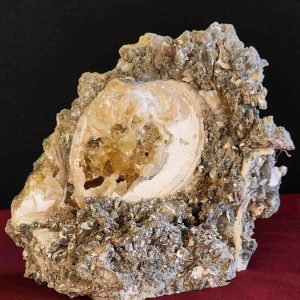
Notes specific to this specimen: Great honey calcite crystals replacing the clam shell trapped in matrix. This piece has a sawn flat bottom so it stands up nicely on its own. Nice display specimen
SIZE: 8″x 5″x 5″
Name / Species: Mercenaria permagna
Age: Pleistocene 2 Million Years
Unit: Nashua Formation
Site: Okeechobee County, Florida
Collected: 2023
Collected by:Documentation: This authentic fossil specimen comes with a Certificate of Authenticity and Origin. In addition, an attractive and informative display card accompanies the specimen.
$425.00Crystalized Clam (OK3)
$425.00 -
Crystalized Clam (OK4)
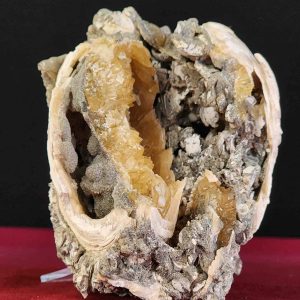
Notes specific to this specimen: There are two clams here in this piece of matrix – one inside the other – creating a double hollow with great dogtooth calcite crystals replacing the inner clamshell and some crystals in the outer one as well. A unique and rare find.
SIZE: 6″x 4″x 5″
Name / Species: Mercenaria permagna
Age: Pleistocene 2 Million Years
Unit: Nashua Formation
Site: Okeechobee County, Florida
Collected: 2023
Collected by:Documentation: This authentic fossil specimen comes with a Certificate of Authenticity and Origin. In addition, an attractive and informative display card accompanies the specimen.
$845.00Crystalized Clam (OK4)
$845.00 -
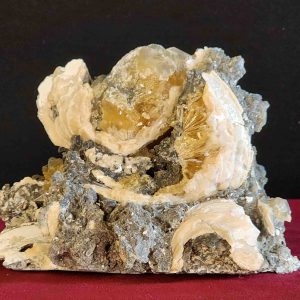
Crystalized Clam (OK5)
Notes specific to this specimen: Great honey calcite crystals replacing multiple clam shells trapped in matrix. Some excellent radial calcite crystals here! This piece has a sawn flat bottom so it stands up nicely on its own.
SIZE: 7″x 5″x 5″
Name / Species: Mercenaria permagna
Age: Pleistocene 2 Million Years
Unit: Nashua Formation
Site: Okeechobee County, Florida
Collected: 2023
Collected by:Documentation: This authentic fossil specimen comes with a Certificate of Authenticity and Origin. In addition, an attractive and informative display card accompanies the specimen.
$550.00Crystalized Clam (OK5)
$550.00 -
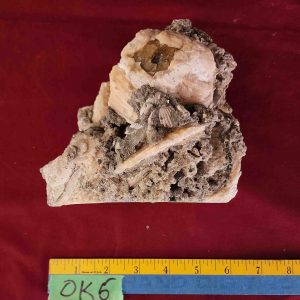
Crystalized Clam (OK6)
Notes specific to this specimen: Great honey calcite crystals replacing multiple clam shells trapped in matrix. This piece has a sawn flat bottom so it stands up nicely on its own
SIZE: 7″x 4″x 5″
Name / Species: Mercenaria permagna
Age: Pleistocene 2 Million Years
Unit: Nashua Formation
Site: Okeechobee County, Florida
Collected:
Collected by:Documentation: This authentic fossil specimen comes with a Certificate of Authenticity and Origin. In addition, an attractive and informative display card accompanies the specimen.
$410.00Crystalized Clam (OK6)
$410.00 -
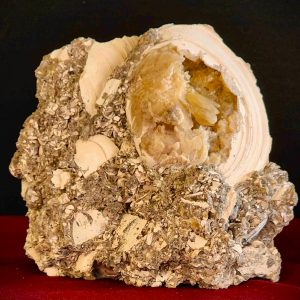
Crystalized Clam (OK7)
Notes specific to this specimen: Great honey calcite crystals replacing one clam shell trapped in matrix. Some excellent radial calcite crystals are on this piece as well.
SIZE: 7″x 5″x 7″
Name / Species: Mercenaria permagna
Age: Pleistocene 2 Million Years
Unit: Nashua Formation
Site: Okeechobee County, Florida
Collected: 2023
Collected by:Documentation: This authentic fossil specimen comes with a Certificate of Authenticity and Origin. In addition, an attractive and informative display card accompanies the specimen.
$310.00Crystalized Clam (OK7)
$310.00 -
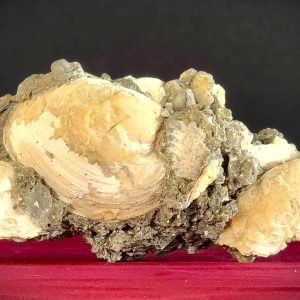
Crystalized Clam (OK8)
Notes specific to this specimen: Calcite replacing multiple clam shells trapped in matrix, some with clearly defined crystals. One of these is a full clam with crystal zones evident.
SIZE: 11″x 5″x 5″
Name / Species: Mercenaria permagna
Age: Pleistocene 2 Million Years
Unit: Nashua Formation
Site: Okeechobee County, Florida
Collected: 2023
Collected by:Documentation: This authentic fossil specimen comes with a Certificate of Authenticity and Origin.
$280.00Crystalized Clam (OK8)
$280.00 -
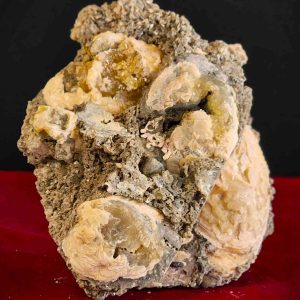
Crystalized Clam (OK9)
Notes specific to this specimen: Lots going on here: Three shells with shiny nice dogtooth calcite crystals trapped in matrix. Plus a superb large shell with great recrystallization.
SIZE: 9″x 8″x 5″
Name / Species: Mercenaria permagna
Age: Pleistocene 2 Million Years
Unit: Nashua Formation
Site: Okeechobee County, Florida
Collected: 2023
Collected by:Documentation: This authentic fossil specimen comes with a Certificate of Authenticity and Origin. In addition, an attractive and informative display card accompanies the specimen.
$385.00Crystalized Clam (OK9)
$385.00 -
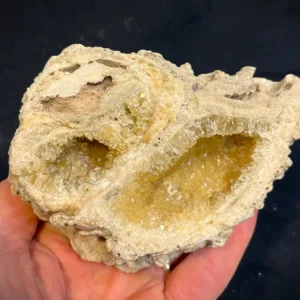
Crystalized Welks (W1)
Notes specific to this specimen: At our Rucks Pit site we sometimes come across fossil welks (conchs). On rare occasions they may be crystalized. This one has been cut in half to show the great crystal-lined hollow section inside. Rare find.
SIZE: 5″
Name / Species: Mercenaria permagna
Age: Pleistocene 2 Million Years
Unit: Nashua Formation
Site: Okeechobee County, Florida
Collected:
Collected by:Documentation: This authentic fossil specimen comes with a Certificate of Authenticity and Origin. In addition, an attractive and informative display card accompanies the specimen.
$480.00Crystalized Welks (W1)
$480.00 -
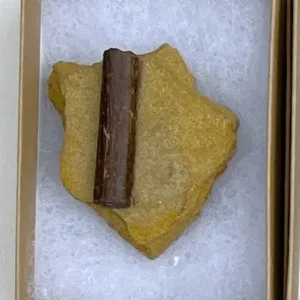
Dinosaur Bone (D21)
Notes specific to this specimen: We learn a lot of stuff from studying the animals and plants of the past. Here’s a great example – It’s a little-known fact that bipedal dinosaurs were far more well-adapted to walking upright than humans have ever been. Modern medicine does, in fact, utilize this important attribute: When the time comes to stabilize someone’s back injury, doctors sometimes attach reinforcement rods to the vertebrae in the injured area and fuse it together with the bone. This exact type of reinforcement is something dinosaurs had already developed 200 million years ago!
At our site in Wyoming we excavated mostly the bones of Edmontosaurus, a bipedal ornithischian dinosaur from the late Cretaceous. In the bonebed we found lots of backbones and, with them, hundreds of pieces of ossified tendon which Edmontosaurus had crisscrossing their vertebrae. These tendons strengthened and reinforced the skeleton, stabilizing their backbone especially in the area of the pelvis. Here we are offering genuine pieces of ossified tendon – mounted on the very matrix we dug it out of – dug directly out of our site in Wyoming. It’s a piece of human history and ancient natural history as well.
SIZE: (box) 2″ x 3″
NAME: Edmontosaurus
AGE: Cretaceous Period – 68 million years
UNIT: Lance Creek Formation
SITE: Lance Creek, WyomingDATE: Early 1990’s
Documentation: This authentic fossil specimen comes with a Certificate of Authenticity and Origin.
$65.00Dinosaur Bone (D21)
$65.00 -
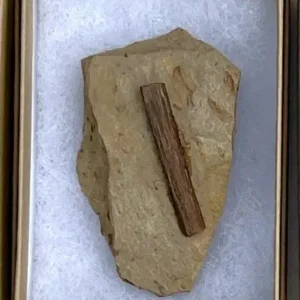
Dinosaur Bone (D22)
Notes specific to this specimen: We learn a lot of stuff from studying the animals and plants of the past. Here’s a great example – It’s a little-known fact that bipedal dinosaurs were far more well-adapted to walking upright than humans have ever been. Modern medicine does, in fact, utilize this important attribute: When the time comes to stabilize someone’s back injury, doctors sometimes attach reinforcement rods to the vertebrae in the injured area and fuse it together with the bone. This exact type of reinforcement is something dinosaurs had already developed 200 million years ago!
At our site in Wyoming we excavated mostly the bones of Edmontosaurus, a bipedal ornithischian dinosaur from the late Cretaceous. In the bonebed we found lots of backbones and, with them, hundreds of pieces of ossified tendon which Edmontosaurus had crisscrossing their vertebrae. These tendons strengthened and reinforced the skeleton, stabilizing their backbone especially in the area of the pelvis. Here we are offering genuine pieces of ossified tendon – mounted on the very matrix we dug it out of – dug directly out of our site in Wyoming. It’s a piece of human history and ancient natural history as well.
SIZE: (box) 2″ x 3″
NAME: Edmontosaurus
AGE: Cretaceous Period – 68 million years
UNIT: Lance Creek Formation
SITE: Lance Creek, WyomingDATE: Early 1990’s
Documentation: This authentic fossil specimen comes with a Certificate of Authenticity and Origin.
$65.00Dinosaur Bone (D22)
$65.00