
Exceptional Museum Specimens
-
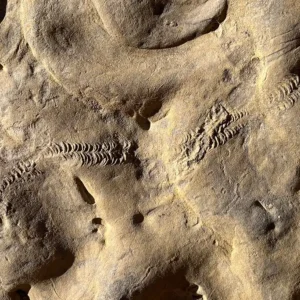
Trilobite Tracks (TRX01)
Notes specific to this specimen: HOW THEY FORMED – This is the largest slab with trilobite tracks and traces ever to be found at this famous site and possibly the largest single specimen of trilobite tracks in the world. These trace fossils formed during the Mississippian Period, roughly 325 million years ago, when trilobites crawled across the soft sediment of an ancient marine seafloor. As they moved, their numerous legs scratched the soft sediment creating paired trails known as Cruziana. Look closely at the ripple patterns: You will see several places where a trilobite was crawling over a ripple crest, making clear tracks, but it then “floated” across a depression, leaving no trail at all. When it reconnected with a ripple crest on the other side, it once-again left a trail. Where a trilobite paused or burrowed shallowly into the sediment, it could leave a broader, bilobed impression called Rusophycus.
Fine sediment subsequently covered these traces, protecting them from currents and erosion. Burial and compaction gradually hardened the sediment into rock, preserving the impressions as natural casts or molds. Much later, uplift, erosion and quarrying exposed the bedding surface, revealing the intricate record of trilobite activity.
Size: 30″ x 40″ X 1.5″
Name / Species: Cruziana and Rusophycus
Age: Mississippian Period, 325 million years
Unit: Tar Springs Formation
Site: Branchville, Perry County, Indiana
Collected: 1992
Collected by: Glen Rockers, PaleoSearchDocumentation: This authentic fossil specimen comes with a Certificate of Authenticity and Origin. In addition, an attractive and informative display card accompanies the specimen.
NOTE: Pickup is available for this specimen. If shipping is required, you will be charged for crating the specimen.
$9,600.00Trilobite Tracks (TRX01)
$9,600.00 -
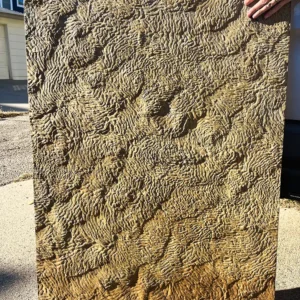
Microbially Induced Sedimentary Structure (MISS01)
Notes specific to this specimen: Incredible specimen! This strange and unique material was discovered years ago when our associate Glen Rockers was visiting a small quarry in Oklahoma. He excavated half a dozen slabs before the quarry worked through the area and the layer was destroyed. Most of the specimens were donated to museums, including one we gave to the Smithsonian in 2024 and another to the Florida Museum of Natural History in 2025.
HOW THEY FORMED
This MISS structure formed when microbial mats, composed primarily of bacteria and algae, colonized the sandy sediments of a coastal environment approximately 305 million years ago. The microbes secreted sticky extracellular substances that bound sand grains together, stabilizing the sediment surface against currents and waves. As sediment accumulated, microbial growth, mat shrinkage, and interactions with moving water produced the complex ridges, wrinkles, and convoluted wavy patterns preserved in the rock. Burial beneath subsequent layers of sediment protected the structures from erosion. Over time, compaction and cementation transformed the sand into Hartshorne Sandstone, preserving this fossilized record of microbial activity in an ancient environment.SIZE: 28″ x 40″ x 1.5″
SHIPPING: If you cannot pick up the specimen in person, additional crating and shipping charges will apply. Please contact us for details.
Documentation: This authentic fossil specimen comes with a Certificate of Authenticity and Origin.
$6,800.00 -
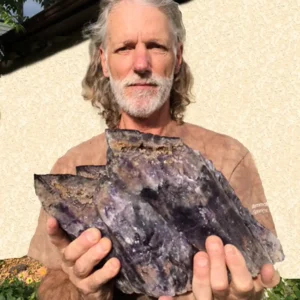
Thunder Bay Amethyst (TBA101) “The Big Kahuna”
Notes specific to this specimen: This is one of the most incredible amethyst specimens ever found anywhere. Truly gigantic crystals of deep purple. This 44-pound kahuna is unlike any other. It was discovered by us in Thunder Bay during the Pacific GeoLab (PGL) expedition there in September 2021. We’ve been displaying it ever since. These massive crystals with deep purple body have a unique final cap of smokey quartz. There are three primary and one secondary crystal termination points.
All sides of the piece are naturally shiny and show striations of the crystal growth stages. The crystal terminations are a complex of interlacing smokey quartz that is quite rare, especially in this region. Almost all large crystals of Thunder Bay amethyst have opaque red or off-white terminations. Translucent purple or smokey terminations in such gigantic crystals is extremely rare. Here, however, the primary crystals end with purple points topped by smokey caps, a doubly-rare discovery. Smokey quartz is rare in this mineralogical province, never mind the fact it is crowning these gigantic deep-purple crystals. The smokey crowns are about ½ inch in thickness overtop their host points below.
There are no alterations or reconstructions to the piece. It is completely natural. There has been no cutting, grinding, or polishing, and no treatments to enhance the colors. The specimen is authentic, and unaltered in any way. These are some of the largest amethyst crystals ever found in North America making this a one-of-a-kind museum specimen.
SHIPPING: If you cannot pick up the specimen in person, additional crating and shipping charges will apply. The piece will ship from our lab in California.
SIZE: 16″x 10″x 10″
Name / Species: Quartz, variety Amethyst
Age: Mesoproterozoic Era – 1.1 billion years
Unit: Archean Granite (unassigned formation)
Site: Diamond Willow Mine, Pearl, Ontario, Canada
Collected:
Collected by: Jon and JulieDocumentation: This authentic fossil specimen comes with a Certificate of Authenticity and Origin.
$12,800.00 -
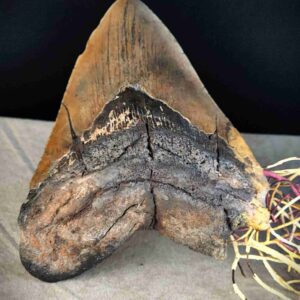
Giant Fossil Shark Tooth with Coral
Notes specific to this specimen: An incredible find! Beautiful huge megalodon shark tooth with soft coral attachment. This 5 1/2″ specimen was discovered in 2000 on the bottom of the ocean off North Carolina and has been kept as found. It was discovered by the greatest shark tooth hunter ever – the late, great, Vito Bertucci – aka “Megalodon Man”. Vito was from the East Coast and well known as the most active collector of giant shark teeth ever and the creator of the largest shark jaw ever assembled. He passed away in 2004 while diving for teeth in the Ogeechee River, Georgia. There is some stabilization in the root but nothing has been done to the tooth itself other than cleaning it. Care has been taken to conserve the piece intact. Even the purple color of the soft coral is preserved. We traded for this from a private collector.
Tooth Size: 5 1/2″
NAME: Otodus megalodon
AGE: Miocene Epoch, 15 million years
SITE: Atlantic Ocean, North Carolina
DATE: 2000Documentation: This authentic fossil specimen comes with a Certificate of Authenticity and Origin.
$2,250.00Giant Fossil Shark Tooth with Coral
$2,250.00 -

Septarian Nodule Bowl
Notes specific to this specimen: An entirely unique item, this septarian nodule was excavated and carved into a bowl by Jon in 2018. The specimen is from the famous Muddy Creek septarian beds in southern Utah, east of Zion National Park. Our friends own a mining claim there and we periodically visit them to collect nodules. Most septarians are not conducive to carving into bowls. This is the only septarian nodule bowl ever sculpted by Jon. He kept it as his own since the day he sculpted it. Alas, it is being displaced from his personal collection by other, larger projects. It has a beautiful shine and fluoresces nicely under UV light. Jon has indicated he may – or may not! – ever do another one.
SIZE: 6″ x 6″ x 4″
SEPTARIAN NODULE BOWL
AGE: Cretaceous Period, 70 million years
UNIT: Frontier Formation
SITE: Orderville, Utah
DATE: 2018Documentation: This authentic fossil specimen comes with a Certificate of Authenticity and Origin.
$485.00Septarian Nodule Bowl
$485.00 -

Potomac Marble Sculpture
Notes specific to this specimen: You won’t find this on the market anywhere! Why? Because we are the only people who excavate and sculpt this beautiful and unusual historic material. Also called Capitol Marble, this Triassic conglomerate is featured as the columns in the US Capitol National Statuary Hall rotunda. They hold up the main Capitol Dome. Interestingly, the location of the quarry where this material was mined was lost for 200 years. But the old quarry site was finally found a few years ago. We visited the site which is along the C & O canal (near milepost 38) in 2024. It hosts the exact same rock we collect for carving at Point of Rocks, some 12 miles upstream where this piece is from. This freeform was sculpted by Jon in 2022 and has a flat bottom for easy display. It features a highly polished partial helix on the front and a contrasting natural back, showing how the rock is found in its rough state.
HOW IT FORMED
Paleozoic mountains that were being uplifted during the Triassic Period as North America and Africa were colliding. About 205 million years ago these rivers carried broken pieces of dolomite into a basin where they were buried. As the layers accumulated in depth, heat and pressure built up and eventually cemented everything together. Later the layers were pushed up and erosion removed the sediments above, exposing this unique rock in certain locations along the Potomac River.
SIZE: 6″ x 4″ x 6″
AGE: Triassic Period, 205 million years
UNIT: Newark Supergroup
SITE: Point of Rocks, Maryland
DATE: 2021Documentation: This authentic fossil specimen comes with a Certificate of Authenticity and Origin.
$525.00Potomac Marble Sculpture
$525.00 -
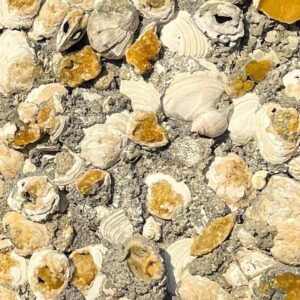
Crystal Clam Wall (OKW7)
Notes specific to this specimen: One of a kind unbelievable specimen! This was dug out in 2023 as several pieces that have been reconstructed into a continuous matrix piece with breathtaking beauty. This is the largest crystal clam matrix specimen in the world. There are over 50 crystalized fossil clams, two crystalized conchs, along with scallops, olive shells, welks, corals and hundreds of other fossil shells in this magnificent museum piece.
HOW THEY FORMED
The area around Lake Okeechobee, Florida was a shallow sea about 2 million years ago. These clams lived in the sandy mud near the shoreline at the time. Sudden storm events – such as hurricanes and tropical storms – periodically buried the area under deep sediments, trapping the clams and other shellfish that lived there. As their bodies decayed, the process left behind cavities in the shells. With the heat and pressure that accompanied the pile-up of sediments, the original shell material (aragonite) became unstable and began to dissolve away. As it happened this provided the elements necessary to grow pure calcite crystals in the open spaces within some of the shells. It has a sturdy backing of plywood with an aluminum frame allowing this piece to be hung either vertically or horizontally. It’s currently on display at 1889 Studios, in the Uptown Rapid (formerly Rushmore Mall) complex in Rapid City, SD. Contact us for shipping options.SIZE: 3′ x 6′ x 10″
NAME: Mercenaria permagna
AGE: Plio-Pleistocene – 2 million years
UNIT: Nashua Formation
SITE: Okeechobee County, Florida
DATE: 2023SHIPPING: If you cannot pick up the specimen in person, additional crating and shipping charges will apply. Please contact us for details.
Documentation: This authentic fossil specimen comes with a Certificate of Authenticity and Origin.
$12,500.00Crystal Clam Wall (OKW7)
$12,500.00
This is the super-serious stuff. One-of-a-kind museum pieces. Sometimes there are specimens so incredibly unique you cannot put them into a category with others – they are light years beyond. Such are the kind of exceptional specimens we showcase here. These are all once-in-a-lifetime specimens. The larger pieces will have extra crating and shipping costs. Please inquire about shipping, or anything else with these pieces, only if you are seriously interested in buying the item.