-
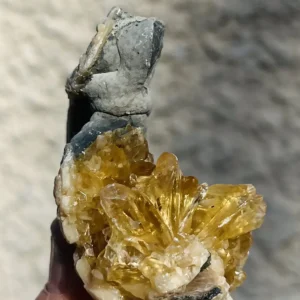
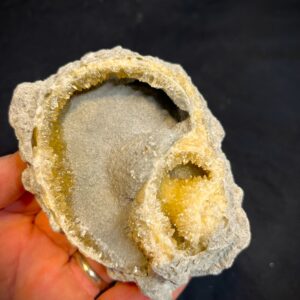
Crystalized Clam (OK14)
Notes specific to this specimen: Exceptional museum grade specimen. Classic full size clam loaded with juicy calcite crystals. No repairs, no touch up, no enhancements – just pure crystal joy. Full clam in matrix. Sits upright.
SIZE: 2″x 1.5″x 1″
Name / Species: Mercenaria permagna
Age: Pleistocene 2 - 4 Million Years
Unit: Nashua Formation
Site: Okeechobee County, Florida
Collected: 2026
Collected by: Jon KramerDocumentation: This authentic fossil specimen comes with a Certificate of Authenticity and Origin.
$75.00Crystalized Clam (OK14)
$75.00 -
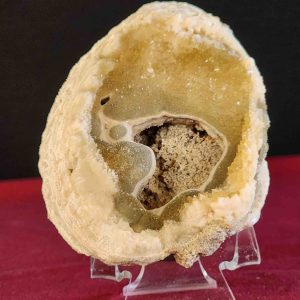
Crystalized Clam (OK2)
Notes specific to this specimen: A complete clam with druzy honey calcite crystals exposed on the front and a recrystallized shell on back. A very unique specimen.
SIZE: 4″x 3″x 2″
Name / Species: Mercenaria permagna
Age: Pleistocene 2 Million Years
Unit: Nashua Formation
Site: Okeechobee County, Florida
Collected: 2023
Collected by:Documentation: This authentic fossil specimen comes with a Certificate of Authenticity and Origin. In addition, an attractive and informative display card accompanies the specimen.
$490.00Crystalized Clam (OK2)
$490.00 -
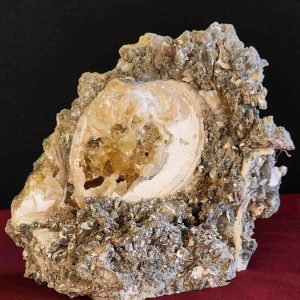
Crystalized Clam (OK3)
Notes specific to this specimen: Great honey calcite crystals replacing the clam shell trapped in matrix. This piece has a sawn flat bottom so it stands up nicely on its own. Nice display specimen
SIZE: 8″x 5″x 5″
Name / Species: Mercenaria permagna
Age: Pleistocene 2 Million Years
Unit: Nashua Formation
Site: Okeechobee County, Florida
Collected: 2023
Collected by:Documentation: This authentic fossil specimen comes with a Certificate of Authenticity and Origin. In addition, an attractive and informative display card accompanies the specimen.
$425.00Crystalized Clam (OK3)
$425.00 -
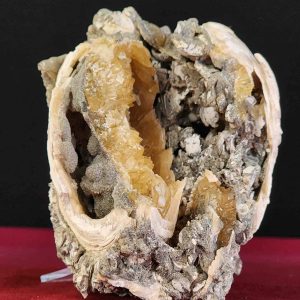
Crystalized Clam (OK4)
Notes specific to this specimen: There are two clams here in this piece of matrix – one inside the other – creating a double hollow with great dogtooth calcite crystals replacing the inner clamshell and some crystals in the outer one as well. A unique and rare find.
SIZE: 6″x 4″x 5″
Name / Species: Mercenaria permagna
Age: Pleistocene 2 Million Years
Unit: Nashua Formation
Site: Okeechobee County, Florida
Collected: 2023
Collected by:Documentation: This authentic fossil specimen comes with a Certificate of Authenticity and Origin. In addition, an attractive and informative display card accompanies the specimen.
$845.00Crystalized Clam (OK4)
$845.00 -
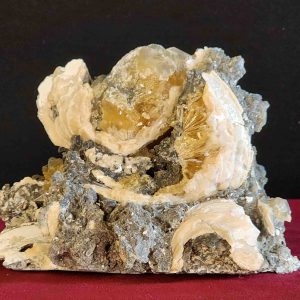
Crystalized Clam (OK5)
Notes specific to this specimen: Great honey calcite crystals replacing multiple clam shells trapped in matrix. Some excellent radial calcite crystals here! This piece has a sawn flat bottom so it stands up nicely on its own.
SIZE: 7″x 5″x 5″
Name / Species: Mercenaria permagna
Age: Pleistocene 2 Million Years
Unit: Nashua Formation
Site: Okeechobee County, Florida
Collected: 2023
Collected by:Documentation: This authentic fossil specimen comes with a Certificate of Authenticity and Origin. In addition, an attractive and informative display card accompanies the specimen.
$550.00Crystalized Clam (OK5)
$550.00 -
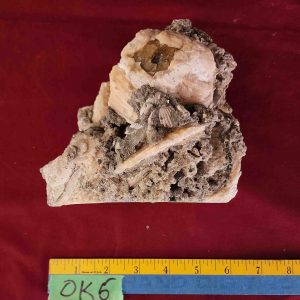
Crystalized Clam (OK6)
Notes specific to this specimen: Great honey calcite crystals replacing multiple clam shells trapped in matrix. This piece has a sawn flat bottom so it stands up nicely on its own
SIZE: 7″x 4″x 5″
Name / Species: Mercenaria permagna
Age: Pleistocene 2 Million Years
Unit: Nashua Formation
Site: Okeechobee County, Florida
Collected:
Collected by:Documentation: This authentic fossil specimen comes with a Certificate of Authenticity and Origin. In addition, an attractive and informative display card accompanies the specimen.
$410.00Crystalized Clam (OK6)
$410.00 -
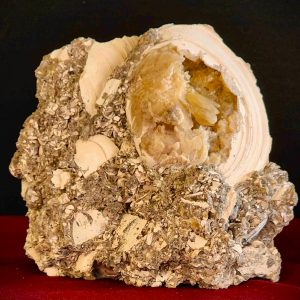
Crystalized Clam (OK7)
Notes specific to this specimen: Great honey calcite crystals replacing one clam shell trapped in matrix. Some excellent radial calcite crystals are on this piece as well.
SIZE: 7″x 5″x 7″
Name / Species: Mercenaria permagna
Age: Pleistocene 2 Million Years
Unit: Nashua Formation
Site: Okeechobee County, Florida
Collected: 2023
Collected by:Documentation: This authentic fossil specimen comes with a Certificate of Authenticity and Origin. In addition, an attractive and informative display card accompanies the specimen.
$310.00Crystalized Clam (OK7)
$310.00 -
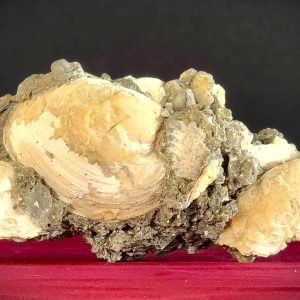
Crystalized Clam (OK8)
Notes specific to this specimen: Calcite replacing multiple clam shells trapped in matrix, some with clearly defined crystals. One of these is a full clam with crystal zones evident.
SIZE: 11″x 5″x 5″
Name / Species: Mercenaria permagna
Age: Pleistocene 2 Million Years
Unit: Nashua Formation
Site: Okeechobee County, Florida
Collected: 2023
Collected by:Documentation: This authentic fossil specimen comes with a Certificate of Authenticity and Origin.
$280.00Crystalized Clam (OK8)
$280.00 -
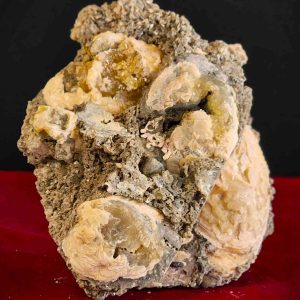
Crystalized Clam (OK9)
Notes specific to this specimen: Lots going on here: Three shells with shiny nice dogtooth calcite crystals trapped in matrix. Plus a superb large shell with great recrystallization.
SIZE: 9″x 8″x 5″
Name / Species: Mercenaria permagna
Age: Pleistocene 2 Million Years
Unit: Nashua Formation
Site: Okeechobee County, Florida
Collected: 2023
Collected by:Documentation: This authentic fossil specimen comes with a Certificate of Authenticity and Origin. In addition, an attractive and informative display card accompanies the specimen.
$385.00Crystalized Clam (OK9)
$385.00 -
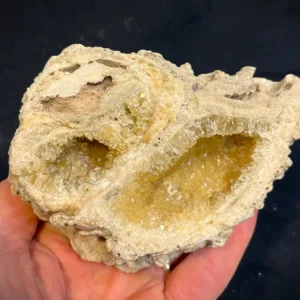
Crystalized Welks (W1)
Notes specific to this specimen: At our Rucks Pit site we sometimes come across fossil welks (conchs). On rare occasions they may be crystalized. This one has been cut in half to show the great crystal-lined hollow section inside. Rare find.
SIZE: 5″
Name / Species: Mercenaria permagna
Age: Pleistocene 2 Million Years
Unit: Nashua Formation
Site: Okeechobee County, Florida
Collected:
Collected by:Documentation: This authentic fossil specimen comes with a Certificate of Authenticity and Origin. In addition, an attractive and informative display card accompanies the specimen.
$480.00Crystalized Welks (W1)
$480.00 -
Crystalized Welks (W2)
Notes specific to this specimen: Fossil welks are much rarer than the clams found at Rucks Pit and most of them have no crystals. But, when you do find a nice crystal-line specimen, there’s nothing like it in the world! This is a single welk with a natural opening on its dorsal (top) allowing you to see the crystal lining of the shell and the gray sparite “floor” that was the sediment which partially filled the shell after the animal had died. Very unusual.
SIZE: 4″
Name / Species: Mercenaria permagna
Age: Pleistocene 2 Million Years
Unit: Nashua Formation
Site: Okeechobee County, Florida
Collected:
Collected by:Documentation: This authentic fossil specimen comes with a Certificate of Authenticity and Origin. In addition, an attractive and informative display card accompanies the specimen.
$165.00Crystalized Welks (W2)
$165.00 -
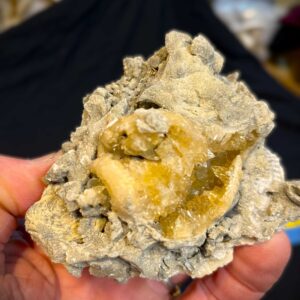
Crystalized Welks (W3)
Notes specific to this specimen: Fossil welks are much rarer than the clams found at Rucks Pit and most of them have no crystals. But, when you do find a nice crystal-line specimen, there’s nothing like it in the world! Here we have a nice matrix specimen with a natural opening on the side of the shell exposing gemmy dog-tooth calcite crystals. They don’t get much better than this!
SIZE: 4″
Name / Species: Mercenaria permagna
Age: Pleistocene 2 Million Years
Unit: Nashua Formation
Site: Okeechobee County, Florida
Collected:
Collected by:Documentation: This authentic fossil specimen comes with a Certificate of Authenticity and Origin. In addition, an attractive and informative display card accompanies the specimen.
$360.00Crystalized Welks (W3)
$360.00
Shop Our Catalog
- Browse All Products
- Agatized Algae
- Agatized Coral
- Banded Iron Formation
- Biwabik Iron Stromatolites
- Cerdito Prospect Rift Crystals
- Dinosaur Bones
- Exceptional Museum Specimens
- Fossil Crabs
- Fossil Echinoids
- Fossil Fern
- Fossil Fish
- Grypania Spiralis
- Gunflint Chert
- Gypsum Selenite
- Biwabik Iron Stromatolites
- Kettleman Hills Fossils
- Kona Dolomite
- Minnesota Thomsonite
- North American Rift
- Rucks Pit
- Specularite
- Sudbury Impactite
- Thunder Bay Amethyst
- Trilobites
- Volcanic Bombs