
-
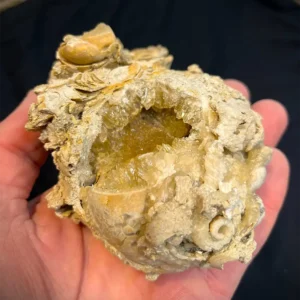
Crystalized Welks (W4)
Notes specific to this specimen: Fossil welks are much rarer than the clams found at Rucks Pit and most of them have no crystals. But, when you do find a nice crystal-line specimen, there’s nothing like it in the world! Here we have a nice natural window on the top side of the shell exposing beautiful gemmy dog-tooth calcite crystals on the inside. Also has a well-defined protoconch (the “tip” where the shell began). They don’t get much better than this!
SIZE: 5″
Name / Species: Mercenaria permagna
Age: Pleistocene 2 Million Years
Unit: Nashua Formation
Site: Okeechobee County, Florida
Collected:
Collected by:Documentation: This authentic fossil specimen comes with a Certificate of Authenticity and Origin. In addition, an attractive and informative display card accompanies the specimen.
$535.00Crystalized Welks (W4)
$535.00 -
Dinosaur Bone (D21)
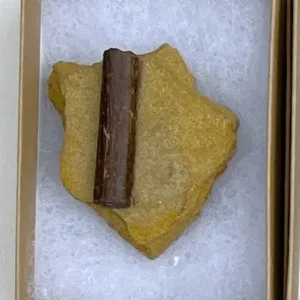
Notes specific to this specimen: We learn a lot of stuff from studying the animals and plants of the past. Here’s a great example – It’s a little-known fact that bipedal dinosaurs were far more well-adapted to walking upright than humans have ever been. Modern medicine does, in fact, utilize this important attribute: When the time comes to stabilize someone’s back injury, doctors sometimes attach reinforcement rods to the vertebrae in the injured area and fuse it together with the bone. This exact type of reinforcement is something dinosaurs had already developed 200 million years ago!
At our site in Wyoming we excavated mostly the bones of Edmontosaurus, a bipedal ornithischian dinosaur from the late Cretaceous. In the bonebed we found lots of backbones and, with them, hundreds of pieces of ossified tendon which Edmontosaurus had crisscrossing their vertebrae. These tendons strengthened and reinforced the skeleton, stabilizing their backbone especially in the area of the pelvis. Here we are offering genuine pieces of ossified tendon – mounted on the very matrix we dug it out of – dug directly out of our site in Wyoming. It’s a piece of human history and ancient natural history as well.
SIZE: (box) 2″ x 3″
NAME: Edmontosaurus
AGE: Cretaceous Period – 68 million years
UNIT: Lance Creek Formation
SITE: Lance Creek, WyomingDATE: Early 1990’s
Documentation: This authentic fossil specimen comes with a Certificate of Authenticity and Origin.
$65.00Dinosaur Bone (D21)
$65.00 -
Dinosaur Bone (D22)
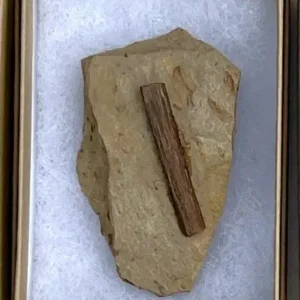
Notes specific to this specimen: We learn a lot of stuff from studying the animals and plants of the past. Here’s a great example – It’s a little-known fact that bipedal dinosaurs were far more well-adapted to walking upright than humans have ever been. Modern medicine does, in fact, utilize this important attribute: When the time comes to stabilize someone’s back injury, doctors sometimes attach reinforcement rods to the vertebrae in the injured area and fuse it together with the bone. This exact type of reinforcement is something dinosaurs had already developed 200 million years ago!
At our site in Wyoming we excavated mostly the bones of Edmontosaurus, a bipedal ornithischian dinosaur from the late Cretaceous. In the bonebed we found lots of backbones and, with them, hundreds of pieces of ossified tendon which Edmontosaurus had crisscrossing their vertebrae. These tendons strengthened and reinforced the skeleton, stabilizing their backbone especially in the area of the pelvis. Here we are offering genuine pieces of ossified tendon – mounted on the very matrix we dug it out of – dug directly out of our site in Wyoming. It’s a piece of human history and ancient natural history as well.
SIZE: (box) 2″ x 3″
NAME: Edmontosaurus
AGE: Cretaceous Period – 68 million years
UNIT: Lance Creek Formation
SITE: Lance Creek, WyomingDATE: Early 1990’s
Documentation: This authentic fossil specimen comes with a Certificate of Authenticity and Origin.
$65.00Dinosaur Bone (D22)
$65.00 -
Dinosaur Bone (D23)
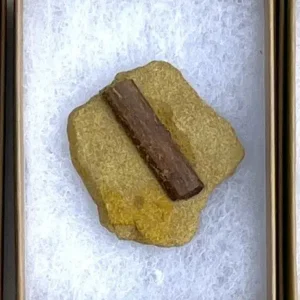
Notes specific to this specimen: We learn a lot of stuff from studying the animals and plants of the past. Here’s a great example – It’s a little-known fact that bipedal dinosaurs were far more well-adapted to walking upright than humans have ever been. Modern medicine does, in fact, utilize this important attribute: When the time comes to stabilize someone’s back injury, doctors sometimes attach reinforcement rods to the vertebrae in the injured area and fuse it together with the bone. This exact type of reinforcement is something dinosaurs had already developed 200 million years ago!
At our site in Wyoming we excavated mostly the bones of Edmontosaurus, a bipedal ornithischian dinosaur from the late Cretaceous. In the bonebed we found lots of backbones and, with them, hundreds of pieces of ossified tendon which Edmontosaurus had crisscrossing their vertebrae. These tendons strengthened and reinforced the skeleton, stabilizing their backbone especially in the area of the pelvis. Here we are offering genuine pieces of ossified tendon – mounted on the very matrix we dug it out of – dug directly out of our site in Wyoming. It’s a piece of human history and ancient natural history as well.
SIZE: (box) 2″ x 3″
NAME: Edmontosaurus
AGE: Cretaceous Period – 68 million years
UNIT: Lance Creek Formation
SITE: Lance Creek, WyomingDATE: Early 1990’s
Documentation: This authentic fossil specimen comes with a Certificate of Authenticity and Origin.
$65.00Dinosaur Bone (D23)
$65.00 -
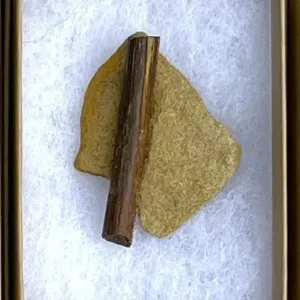
Dinosaur Bone (D24)
Notes specific to this specimen: We learn a lot of stuff from studying the animals and plants of the past. Here’s a great example – It’s a little-known fact that bipedal dinosaurs were far more well-adapted to walking upright than humans have ever been. Modern medicine does, in fact, utilize this important attribute: When the time comes to stabilize someone’s back injury, doctors sometimes attach reinforcement rods to the vertebrae in the injured area and fuse it together with the bone. This exact type of reinforcement is something dinosaurs had already developed 200 million years ago!
At our site in Wyoming we excavated mostly the bones of Edmontosaurus, a bipedal ornithischian dinosaur from the late Cretaceous. In the bonebed we found lots of backbones and, with them, hundreds of pieces of ossified tendon which Edmontosaurus had crisscrossing their vertebrae. These tendons strengthened and reinforced the skeleton, stabilizing their backbone especially in the area of the pelvis. Here we are offering genuine pieces of ossified tendon – mounted on the very matrix we dug it out of – dug directly out of our site in Wyoming. It’s a piece of human history and ancient natural history as well.
SIZE: (box) 2″ x 3″
NAME: Edmontosaurus
AGE: Cretaceous Period – 68 million years
UNIT: Lance Creek Formation
SITE: Lance Creek, WyomingDATE: Early 1990’s
Documentation: This authentic fossil specimen comes with a Certificate of Authenticity and Origin.
$65.00Dinosaur Bone (D24)
$65.00 -
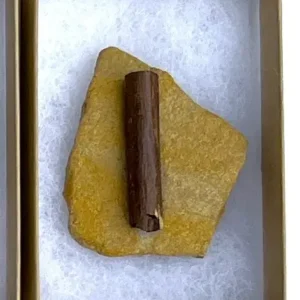
Dinosaur Bone (D25)
Notes specific to this specimen: We learn a lot of stuff from studying the animals and plants of the past. Here’s a great example – It’s a little-known fact that bipedal dinosaurs were far more well-adapted to walking upright than humans have ever been. Modern medicine does, in fact, utilize this important attribute: When the time comes to stabilize someone’s back injury, doctors sometimes attach reinforcement rods to the vertebrae in the injured area and fuse it together with the bone. This exact type of reinforcement is something dinosaurs had already developed 200 million years ago!
At our site in Wyoming we excavated mostly the bones of Edmontosaurus, a bipedal ornithischian dinosaur from the late Cretaceous. In the bonebed we found lots of backbones and, with them, hundreds of pieces of ossified tendon which Edmontosaurus had crisscrossing their vertebrae. These tendons strengthened and reinforced the skeleton, stabilizing their backbone especially in the area of the pelvis. Here we are offering genuine pieces of ossified tendon – mounted on the very matrix we dug it out of – dug directly out of our site in Wyoming. It’s a piece of human history and ancient natural history as well.
SIZE: (box) 2″ x 3″
NAME: Edmontosaurus
AGE: Cretaceous Period – 68 million years
UNIT: Lance Creek Formation
SITE: Lance Creek, WyomingDATE: Early 1990’s
Documentation: This authentic fossil specimen comes with a Certificate of Authenticity and Origin.
$65.00Dinosaur Bone (D25)
$65.00 -
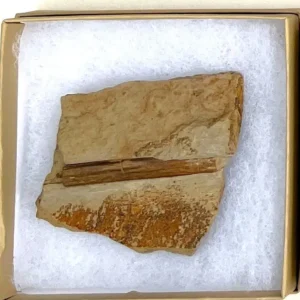
Dinosaur Bone (D31)
Notes specific to this specimen: We learn a lot of stuff from studying the animals and plants of the past. Here’s a great example – It’s a little-known fact that bipedal dinosaurs were far more well-adapted to walking upright than humans have ever been. Modern medicine does, in fact, utilize this important attribute: When the time comes to stabilize someone’s back injury, doctors sometimes attach reinforcement rods to the vertebrae in the injured area and fuse it together with the bone. This exact type of reinforcement is something dinosaurs had already developed 200 million years ago!
At our site in Wyoming we excavated mostly the bones of Edmontosaurus, a bipedal ornithischian dinosaur from the late Cretaceous. In the bonebed we found lots of backbones and, with them, hundreds of pieces of ossified tendon which Edmontosaurus had crisscrossing their vertebrae. These tendons strengthened and reinforced the skeleton, stabilizing their backbone especially in the area of the pelvis. Here we are offering genuine pieces of ossified tendon – mounted on the very matrix we dug it out of – dug directly out of our site in Wyoming. It’s a piece of human history and ancient natural history as well.
SIZE: (box) 3″ x 3″
NAME: Edmontosaurus
AGE: Cretaceous Period – 68 million years
UNIT: Lance Creek Formation
SITE: Lance Creek, WyomingDATE: Early 1990’s
Documentation: This authentic fossil specimen comes with a Certificate of Authenticity and Origin.
$85.00Dinosaur Bone (D31)
$85.00 -
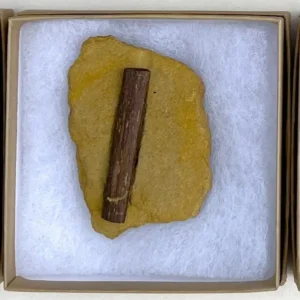
Dinosaur Bone (D32)
Notes specific to this specimen: We learn a lot of stuff from studying the animals and plants of the past. Here’s a great example – It’s a little-known fact that bipedal dinosaurs were far more well-adapted to walking upright than humans have ever been. Modern medicine does, in fact, utilize this important attribute: When the time comes to stabilize someone’s back injury, doctors sometimes attach reinforcement rods to the vertebrae in the injured area and fuse it together with the bone. This exact type of reinforcement is something dinosaurs had already developed 200 million years ago!
At our site in Wyoming we excavated mostly the bones of Edmontosaurus, a bipedal ornithischian dinosaur from the late Cretaceous. In the bonebed we found lots of backbones and, with them, hundreds of pieces of ossified tendon which Edmontosaurus had crisscrossing their vertebrae. These tendons strengthened and reinforced the skeleton, stabilizing their backbone especially in the area of the pelvis. Here we are offering genuine pieces of ossified tendon – mounted on the very matrix we dug it out of – dug directly out of our site in Wyoming. It’s a piece of human history and ancient natural history as well.
SIZE: (box) 3″ x 3″
NAME: Edmontosaurus
AGE: Cretaceous Period – 68 million years
UNIT: Lance Creek Formation
SITE: Lance Creek, WyomingDATE: Early 1990’s
Documentation: This authentic fossil specimen comes with a Certificate of Authenticity and Origin.
$85.00Dinosaur Bone (D32)
$85.00 -
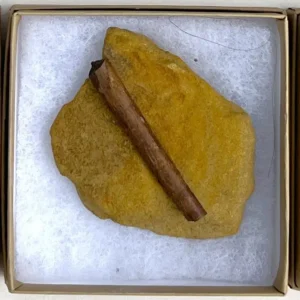
Dinosaur Bone (D33)
Notes specific to this specimen: We learn a lot of stuff from studying the animals and plants of the past. Here’s a great example – It’s a little-known fact that bipedal dinosaurs were far more well-adapted to walking upright than humans have ever been. Modern medicine does, in fact, utilize this important attribute: When the time comes to stabilize someone’s back injury, doctors sometimes attach reinforcement rods to the vertebrae in the injured area and fuse it together with the bone. This exact type of reinforcement is something dinosaurs had already developed 200 million years ago!
At our site in Wyoming we excavated mostly the bones of Edmontosaurus, a bipedal ornithischian dinosaur from the late Cretaceous. In the bonebed we found lots of backbones and, with them, hundreds of pieces of ossified tendon which Edmontosaurus had crisscrossing their vertebrae. These tendons strengthened and reinforced the skeleton, stabilizing their backbone especially in the area of the pelvis. Here we are offering genuine pieces of ossified tendon – mounted on the very matrix we dug it out of – dug directly out of our site in Wyoming. It’s a piece of human history and ancient natural history as well.
SIZE: (box) 3″ x 3″
NAME: Edmontosaurus
AGE: Cretaceous Period – 68 million years
UNIT: Lance Creek Formation
SITE: Lance Creek, WyomingDATE: Early 1990’s
Documentation: This authentic fossil specimen comes with a Certificate of Authenticity and Origin.
$85.00Dinosaur Bone (D33)
$85.00 -
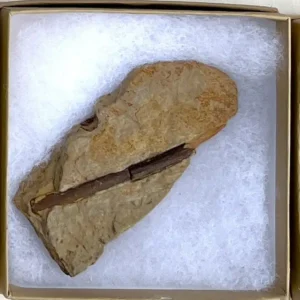
Dinosaur Bone (D34)
Notes specific to this specimen: We learn a lot of stuff from studying the animals and plants of the past. Here’s a great example – It’s a little-known fact that bipedal dinosaurs were far more well-adapted to walking upright than humans have ever been. Modern medicine does, in fact, utilize this important attribute: When the time comes to stabilize someone’s back injury, doctors sometimes attach reinforcement rods to the vertebrae in the injured area and fuse it together with the bone. This exact type of reinforcement is something dinosaurs had already developed 200 million years ago!
At our site in Wyoming we excavated mostly the bones of Edmontosaurus, a bipedal ornithischian dinosaur from the late Cretaceous. In the bonebed we found lots of backbones and, with them, hundreds of pieces of ossified tendon which Edmontosaurus had crisscrossing their vertebrae. These tendons strengthened and reinforced the skeleton, stabilizing their backbone especially in the area of the pelvis. Here we are offering genuine pieces of ossified tendon – mounted on the very matrix we dug it out of – dug directly out of our site in Wyoming. It’s a piece of human history and ancient natural history as well.
SIZE: (box) 3″ x 3″
NAME: Edmontosaurus
AGE: Cretaceous Period – 68 million years
UNIT: Lance Creek Formation
SITE: Lance Creek, WyomingDATE: Early 1990’s
Documentation: This authentic fossil specimen comes with a Certificate of Authenticity and Origin.
$85.00Dinosaur Bone (D34)
$85.00 -
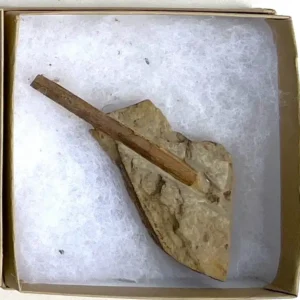
Dinosaur Bone (D35)
Notes specific to this specimen: We learn a lot of stuff from studying the animals and plants of the past. Here’s a great example – It’s a little-known fact that bipedal dinosaurs were far more well-adapted to walking upright than humans have ever been. Modern medicine does, in fact, utilize this important attribute: When the time comes to stabilize someone’s back injury, doctors sometimes attach reinforcement rods to the vertebrae in the injured area and fuse it together with the bone. This exact type of reinforcement is something dinosaurs had already developed 200 million years ago!
At our site in Wyoming we excavated mostly the bones of Edmontosaurus, a bipedal ornithischian dinosaur from the late Cretaceous. In the bonebed we found lots of backbones and, with them, hundreds of pieces of ossified tendon which Edmontosaurus had crisscrossing their vertebrae. These tendons strengthened and reinforced the skeleton, stabilizing their backbone especially in the area of the pelvis. Here we are offering genuine pieces of ossified tendon – mounted on the very matrix we dug it out of – dug directly out of our site in Wyoming. It’s a piece of human history and ancient natural history as well.
SIZE: (box) 3″ x 3″
NAME: Edmontosaurus
AGE: Cretaceous Period – 68 million years
UNIT: Lance Creek Formation
SITE: Lance Creek, WyomingDATE: Early 1990’s
Documentation: This authentic fossil specimen comes with a Certificate of Authenticity and Origin.
$85.00Dinosaur Bone (D35)
$85.00 -
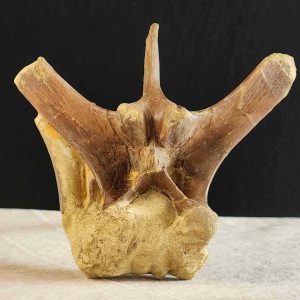
Dinosaur Bones (D1)
Notes specific to this specimen: This is a very well preserved neural arch and process of a cervical vertebrae, probably about midway down the neck of a hadrosaur (bipedal) dinosaur. The centrum is not present. The fine detail on the bone surface is exquisite and remarkably well preserved. This exceptional piece has no reconstruction.
SIZE: 5″ x 5″ x 3″
NAME: Edmontosaurus
AGE: Cretaceous Period – 68 million years
UNIT: Lance Creek Formation
SITE: Lance Creek, WyomingDATE: 1992
Documentation: This authentic fossil specimen comes with a Certificate of Authenticity and Origin.
$820.00Dinosaur Bones (D1)
$820.00
Shop Our Catalog
- Browse All Products
- Agatized Algae
- Agatized Coral
- Banded Iron Formation
- Biwabik Iron Stromatolites
- Cerdito Prospect Rift Crystals
- Dinosaur Bones
- Exceptional Museum Specimens
- Fossil Crabs
- Fossil Echinoids
- Fossil Fern
- Fossil Fish
- Grypania Spiralis
- Gunflint Chert
- Gypsum Selenite
- Biwabik Iron Stromatolites
- Kettleman Hills Fossils
- Kona Dolomite
- Minnesota Thomsonite
- North American Rift
- Rucks Pit
- Specularite
- Sudbury Impactite
- Thunder Bay Amethyst
- Trilobites
- Volcanic Bombs