-
Thunder Bay Amethyst (TBA101) “The Big Kahuna”
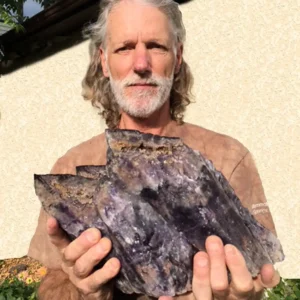
Notes specific to this specimen: This is one of the most incredible amethyst specimens ever found anywhere. Truly gigantic crystals of deep purple. This 44-pound kahuna is unlike any other. It was discovered by us in Thunder Bay during the Pacific GeoLab (PGL) expedition there in September 2021. We’ve been displaying it ever since. These massive crystals with deep purple body have a unique final cap of smokey quartz. There are three primary and one secondary crystal termination points.
All sides of the piece are naturally shiny and show striations of the crystal growth stages. The crystal terminations are a complex of interlacing smokey quartz that is quite rare, especially in this region. Almost all large crystals of Thunder Bay amethyst have opaque red or off-white terminations. Translucent purple or smokey terminations in such gigantic crystals is extremely rare. Here, however, the primary crystals end with purple points topped by smokey caps, a doubly-rare discovery. Smokey quartz is rare in this mineralogical province, never mind the fact it is crowning these gigantic deep-purple crystals. The smokey crowns are about ½ inch in thickness overtop their host points below.
There are no alterations or reconstructions to the piece. It is completely natural. There has been no cutting, grinding, or polishing, and no treatments to enhance the colors. The specimen is authentic, and unaltered in any way. These are some of the largest amethyst crystals ever found in North America making this a one-of-a-kind museum specimen.
SHIPPING: If you cannot pick up the specimen in person, additional crating and shipping charges will apply. The piece will ship from our lab in California.
SIZE: 16″x 10″x 10″
Name / Species: Quartz, variety Amethyst
Age: Mesoproterozoic Era – 1.1 billion years
Unit: Archean Granite (unassigned formation)
Site: Diamond Willow Mine, Pearl, Ontario, Canada
Collected:
Collected by: Jon and JulieDocumentation: This authentic fossil specimen comes with a Certificate of Authenticity and Origin.
$12,800.00 -
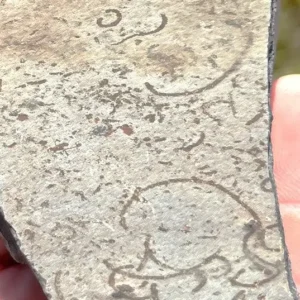
Grypania Spiralis (GRY12)
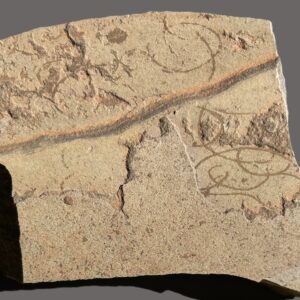
Notes specific to this specimen: An absolute stellar specimen! There were only a few specimens recovered that showed such abundance and contrast. This particular horizon we called “Grypania Heaven” due to its stellar appearance. This super-rich slab is populated with dozens of showy and very distinct Grypania, many with characteristic curvature and arcs. In addition, some of the specimens have desiccation distortion along the sheath
SIZE: 3″ x 5″
NAME: Grypania spiralis
AGE: Paleoproterozoic Era / 2.1 billion years
UNIT: Negaunee Iron Formation
SITE: Empire Mine, Palmer, Michigan$12,500.00Grypania Spiralis (GRY12)
$12,500.00 -
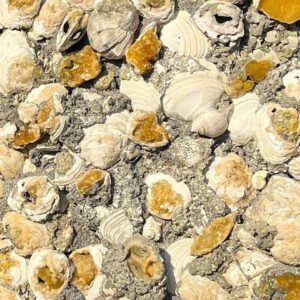
Crystal Clam Wall (OKW7)
Notes specific to this specimen: One of a kind unbelievable specimen! This was dug out in 2023 as several pieces that have been reconstructed into a continuous matrix piece with breathtaking beauty. This is the largest crystal clam matrix specimen in the world. There are over 50 crystalized fossil clams, two crystalized conchs, along with scallops, olive shells, welks, corals and hundreds of other fossil shells in this magnificent museum piece.
HOW THEY FORMED
The area around Lake Okeechobee, Florida was a shallow sea about 2 million years ago. These clams lived in the sandy mud near the shoreline at the time. Sudden storm events – such as hurricanes and tropical storms – periodically buried the area under deep sediments, trapping the clams and other shellfish that lived there. As their bodies decayed, the process left behind cavities in the shells. With the heat and pressure that accompanied the pile-up of sediments, the original shell material (aragonite) became unstable and began to dissolve away. As it happened this provided the elements necessary to grow pure calcite crystals in the open spaces within some of the shells. It has a sturdy backing of plywood with an aluminum frame allowing this piece to be hung either vertically or horizontally. It’s currently on display at 1889 Studios, in the Uptown Rapid (formerly Rushmore Mall) complex in Rapid City, SD. Contact us for shipping options.SIZE: 3′ x 6′ x 10″
NAME: Mercenaria permagna
AGE: Plio-Pleistocene – 2 million years
UNIT: Nashua Formation
SITE: Okeechobee County, Florida
DATE: 2023Documentation: This authentic fossil specimen comes with a Certificate of Authenticity and Origin. In addition, an informative display card accompanies the specimen
$12,500.00Crystal Clam Wall (OKW7)
$12,500.00 -
Grypania Spiralis (GRY2)
Notes specific to this specimen: Nice cabinet specimen showing several nice segments of Grypania with the classic curving arc formed by this species. Some segments show great examples of what’s been described as “desiccation” of the outer sheath along its length. This results in impingement of the sheath between individual cells, giving it a “bumpy” appearance. The desiccated segments are very rare.
SIZE: 4″ x 5″ x 0.75″
NAME: Grypania spiralis
AGE: Paleoproterozoic Era / 2.1 billion years
UNIT: Negaunee Iron Formation
SITE: Empire Mine, Palmer, Michigan$6,500.00Grypania Spiralis (GRY2)
$6,500.00 -
Grypania Spiralis (GRY11)
Notes specific to this specimen: Nice hand-sized slab with several showy and very distinct Grypania strings, some of which have characteristic curvature and arcs. In addition, some of the specimens have desiccation distortion along the sheath.
SIZE: 5″ x 6″
NAME: Grypania spiralis
AGE: Paleoproterozoic Era / 2.1 billion years
UNIT : Negaunee Iron Formation
SITE: Empire Mine, Palmer, Michigan$2,800.00Grypania Spiralis (GRY11)
$2,800.00 -
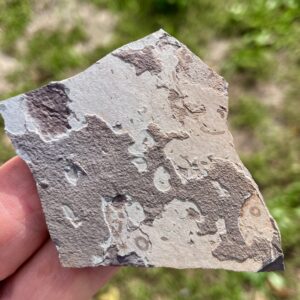
Grypania Spiralis (GRY9)
Notes specific to this specimen: Nice slab showing several clear segments of Grypania, a couple with the classic full circles and others with curving arc formed by this species. A couple of the segments – like the circle in the lower middle – show examples of what’s been described as “desiccation” of the outer sheath along its length. This results in impingement of the sheath between individual cells, giving it a “bumpy” appearance. The desiccated segments are very rare.
SIZE: 3″ x 3″
NAME: Grypania spiralis
AGE: Paleoproterozoic Era / 2.1 billion years
UNIT: Negaunee Iron Formation
SITE: Empire Mine, Palmer, Michigan$2,600.00Grypania Spiralis (GRY9)
$2,600.00 -
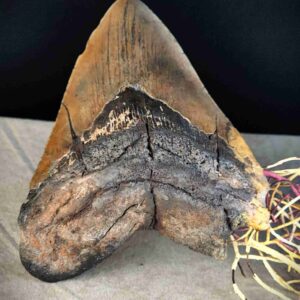
Giant Fossil Shark Tooth with Coral
Notes specific to this specimen: An incredible find! Beautiful huge megalodon shark tooth with soft coral attachment. This 5 1/2″ specimen was discovered in 2000 on the bottom of the ocean off North Carolina and has been kept as found. It was discovered by the greatest shark tooth hunter ever – the late, great, Vito Bertucci – aka “Megalodon Man”. Vito was from the East Coast and well known as the most active collector of giant shark teeth ever and the creator of the largest shark jaw ever assembled. He passed away in 2004 while diving for teeth in the Ogeechee River, Georgia. There is some stabilization in the root but nothing has been done to the tooth itself other than cleaning it. Care has been taken to conserve the piece intact. Even the purple color of the soft coral is preserved. We traded for this from a private collector.
Tooth Size: 5 1/2″
NAME: Otodus megalodon
AGE: Miocene Epoch, 15 million years
SITE: Atlantic Ocean, North Carolina
DATE: 2000Documentation: This authentic fossil specimen comes with a Certificate of Authenticity and Origin.
$2,250.00Giant Fossil Shark Tooth with Coral
$2,250.00 -
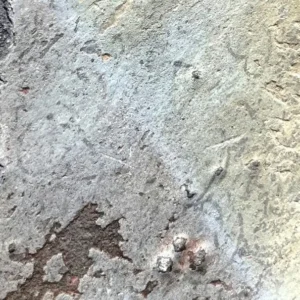
Grypania Spiralis (GRY10)
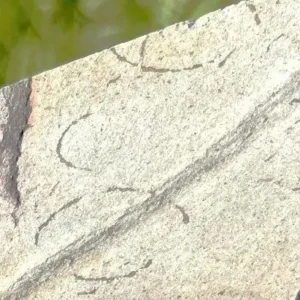
Notes specific to this specimen: This sizeable slab shows abundant evidence of fragmentary Grypania, although there are some longer pieces with the telltale arching strings. The impressions are numerous but not very apparent except under close inspection.
SIZE: 4″ x 6″
NAME: Grypania spiralis
AGE: Paleoproterozoic Era / 2.1 billion years
UNIT : Negaunee Iron Formation
SITE: Empire Mine, Palmer, Michigan$1,850.00Grypania Spiralis (GRY10)
$1,850.00 -
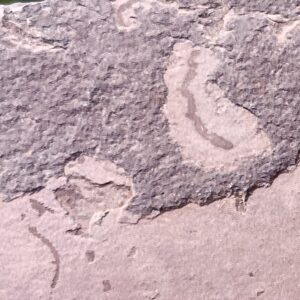
Grypania Spiralis (GRY7)
Notes specific to this specimen: This piece shows clear segments of Grypania, a couple with the classic curving arc formed by this species. The most notable, however, is the clear “squiggly” segment in the top left. It is a perfect example of what’s been described as “desiccation” of the outer sheath along its length, resulting in impingement of the sheath between individual cells. It doesn’t get any more graphic than this!
SIZE: 2″ x 3″
NAME: Grypania spiralis
AGE: Paleoproterozoic Era / 2.1 billion years
UNIT: Negaunee Iron Formation
SITE: Empire Mine, Palmer, Michigan$1,800.00Grypania Spiralis (GRY7)
$1,800.00 -
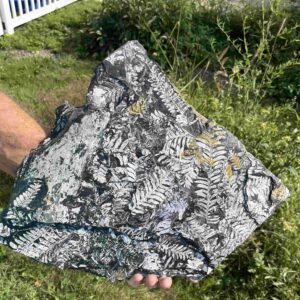
St Clair Flora – rare preservation (F6)
Notes specific to this specimen: Two sided specimen – front and back are equally compelling with a dense accumulation of ferns. An attractive and informative display card accompanies the specimen.
NAME: Alethopteris
AGE: Carboniferous Period – 305 million years
UNIT: Llewellyn Formation
SITE: Schuylkill County, PennsylvaniaSize: 18″ x 14″ x 1″
Documentation: This authentic fossil specimen comes with a Certificate of Authenticity and Origin. In addition, an attractive and informative display card accompanies the specimen.
$1,450.00St Clair Flora – rare preservation (F6)
$1,450.00 -
North American Rift (RIFT5)
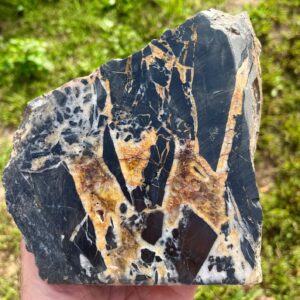
Notes specific to this specimen: Incredible find! You can just about feel the rock ripping apart – a very dynamic piece. One of the best we’ve seen. Beautiful citrine and smoky quartz infilling in these graphic fractures of jet-black Rove Formation. Cut front face is polished. This specimen is a “stand-up” with a cut flat bottom allowing it to sit upright to show off the display face. Back is naturally rough.
SIZE: 5″x 6″x 2″
Minerals: White Quartz, Citrine, Fluorite
Age: Mesoproterozoic Era – 1.1 billion years
Unit: Rove Formation
Site: Cerdito Prospect, Thunder Bay, Ontario, Canada
Collected: 2025
By: Jon & JulieDocumentation: This authentic fossil specimen comes with a Certificate of Authenticity and Origin.
$1,425.00North American Rift (RIFT5)
$1,425.00 -
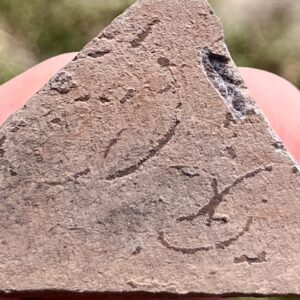
Grypania Spiralis (GRY8)
Notes specific to this specimen: Nice slab showing several clear segments of Grypania, a couple with the classic full circles and others with curving arc formed by this species. A couple of the segments – like the circle in the lower middle – show examples of what’s been described as “desiccation” of the outer sheath along its length. This results in impingement of the sheath between individual cells, giving it a “bumpy” appearance. The desiccated segments are very rare.
SIZE: 1.5″ x 2″
NAME: Grypania spiralis
AGE: Paleoproterozoic Era / 2.1 billion years
UNIT: Negaunee Iron Formation
SITE: Empire Mine, Palmer, Michigan$950.00Grypania Spiralis (GRY8)
$950.00
Shop Our Catalog
- Browse All Products
- Agatized Algae
- Agatized Coral
- Banded Iron Formation
- Biwabik Iron Stromatolites
- Cerdito Prospect Rift Crystals
- Dinosaur Bones
- Exceptional Museum Specimens
- Fossil Crabs
- Fossil Echinoids
- Fossil Fern
- Fossil Fish
- Grypania Spiralis
- Gunflint Chert
- Gypsum Selenite
- Biwabik Iron Stromatolites
- Kettleman Hills Fossils
- Kona Dolomite
- Minnesota Thomsonite
- North American Rift
- Rucks Pit
- Specularite
- Sudbury Impactite
- Thunder Bay Amethyst
- Trilobites
- Volcanic Bombs