- The product "Agatized Coral (AC1)" has been removed from your wishlist because it can no longer be purchased.
- Failed to add “Agatized Coral (AC1)” to your wishlist
-
$265.00
Volcanic Bomb (EB4)
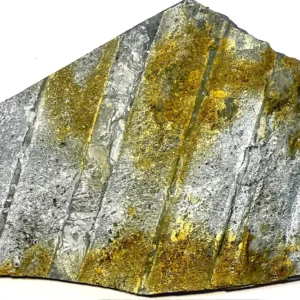
Notes specific to this specimen: Large classic plump fusiform bomb with great aerodynamic striations. It looks like it encountered another in flight but did not complete the merging with it. Natural breaks reveals chalcedony interior which fluoresces a vibrant green. A great specimen.
SIZE: 10″ x 5″ x 4″
NAME: Various forms
AGE: Pliocene Epoch- 5 million years
UNIT: Banbury Formation
SITE: Elko County, NevadaDATE: 2020
Documentation: This authentic specimen comes with a Certificate of Authenticity and Origin documenting where, when, and who collected and prepared it.
-
$365.00
Iron Stromatolites (ME3)
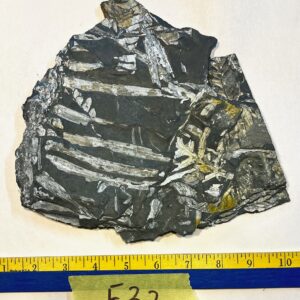
Notes specific to this specimen: Rare white colonies with dark banded growth rings. Some have branchings. Specimen found in 1990s at the old Mary Ellen Mine in Biwabik, Minnesota, the type locality for the Biwabik Iron Formation. Notice the silvery spots of concentrated iron between the colonies.
SIZE: 3″ x 5″ x .3″
Name: Collenia undosa
Unit: Biwabik Iron Formation
Site: Biwabik Iron Range, Minnesota
Date: Mid 1990sDocumentation: This authentic specimen comes with a Certificate of Authenticity and Origin documenting where, when, and who collected and prepared it.
-
$110.00
Fossil Fern (FP11)
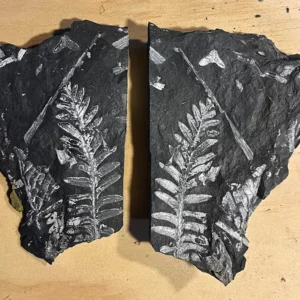
Notes specific to this specimen: Beautiful preservation – with both sides. Alethopteris was a primary flora in Pennsylvania’s Carboniferous coal swamps. Our site is known for its exceptional preservation and this specimen illustrates that perfectly. This piece was excavated 30 years ago and has just been prepared.
Size: 3″ x 5″ x 1.5″ (pair)
Name / Species: Alethopteris
Age: Carboniferous Period - 305 million years
Unit: Llewellyn Formation
Site: Schuylkill County, Pennsylvania
Collected: 1996
Collected by: Potomac Museum GroupDocumentation: This authentic specimen comes with a Certificate of Authenticity and Origin documenting where, when, and who collected and prepared it.
-
$550.00
Fossil Fern (F33)
Notes specific to this specimen: Beautiful preservation. Large and impressive section of Sigillaria trunk. Sigillaria was a towering, tree-like lycopsid of Pennsylvania’s Carboniferous coal swamps. Our site is known for its exceptional preservation and this specimen illustrates that perfectly. This is one of the best specimens of Sigillaria trunk we’ve ever found. This piece was excavated 30 years ago and has just been prepared.
Size: 12″ x 18″ x 1″
Name / Species: Alethopteris and Stigmaria
Age: Carboniferous Period - 305 million years
Unit: Llewellyn Formation
Site: Schuylkill County, Pennsylvania
Collected: 1996
Collected by: Potomac Museum GroupDocumentation: This authentic specimen comes with a Certificate of Authenticity and Origin documenting where, when, and who collected and prepared it.
-
$165.00
Fossil Fern (F32)
Notes specific to this specimen: Our site is known for its exceptional preservation and this specimen illustrates that perfectly. Here are nice groups of ferns and excellent Stigmaria specimen besides. Stigmaria is the distinctive fossilized root system of giant Carboniferous lycopsid trees such as Lepidodendron and Sigillaria. Our site has the best preserved Stigmaria anywhere – with not only the “tap root” well preserved but also showing the rootlets branching off of it. This piece was excavated 30 years ago and has just been prepared.
Size: 8″ x 8″ x 1″
Name / Species: Alethopteris and Stigmaria
Age: Carboniferous Period - 305 million years
Unit: Llewellyn Formation
Site: Schuylkill County, Pennsylvania
Collected: 1996
Collected by: Potomac Museum GroupDocumentation: This authentic specimen comes with a Certificate of Authenticity and Origin documenting where, when, and who collected and prepared it.
-
$280.00
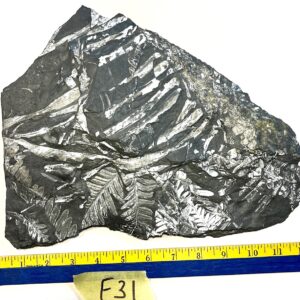
Fossil Fern (F31)
Notes specific to this specimen: Our site is known for its exceptional preservation and this specimen illustrates that perfectly. Here we have abundant ferns grouped on one side and an excellent Stigmaria specimen on the other. Stigmaria is the distinctive fossilized root system of giant Carboniferous lycopsid trees such as Lepidodendron and Sigillaria. Our site has the best preserved Stigmaria anywhere – with not only the “tap root” well preserved, but also showing the rootlets branching off of it. This piece was excavated 30 years ago and has just been prepared.
Size: 10″ x 12″ x 1.5″
Name / Species: Alethopteris and Stigmaria
Age: Carboniferous Period - 305 million years
Unit: Llewellyn Formation
Site: Schuylkill County, Pennsylvania
Collected: 1996
Collected by: Potomac Museum GroupDocumentation: This authentic specimen comes with a Certificate of Authenticity and Origin documenting where, when, and who collected and prepared it.
-
 $350.00
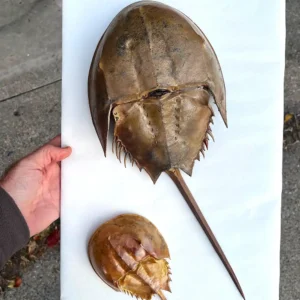
Horseshoe Crab (HSC-3)
Notes specific to this specimen: Here we have two specimens, one adult and one juvenile. Both are rich in color. The smaller specimen has a missing corner on the back of its cephalon. Like all our horseshoe crab specimens this one does not have gills or undersides. (Birds and other scavengers feed upon the soft undersides long before we get there.) What you will receive is just the carapace you see here. The specimen is easily removed from its cardboard backing and can be mounted directly on a wall or in a shadowbox.
SIZE including telson (tail): a) 8″x 18″x 3″ b) 4.4″x 6.5″x 1.5″
Name / Species: Limulus polyphemus
Age: Recent
Unit:
Site: Gulf of Mexico, Florida
Collected: 2025
Collected by: Jon and JulieDocumentation: This authentic specimen comes with a Certificate of Authenticity and Origin documenting where, when, and who collected and prepared it.
-
 $285.00
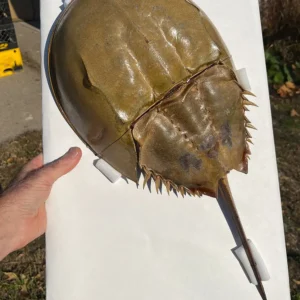
Horseshoe Crab (HSC-2)
Notes specific to this specimen: A very large specimen at 22″ long Beautiful shiny beige shell with no damage. Like all our horseshoe crab specimens this one does not have gills or undersides. (Birds and other scavengers feed upon the soft undersides long before we get there.) What you will receive is just the carapace you see here. The specimen is easily removed from its cardboard backing and can be mounted directly on a wall or in a shadowbox.
SIZE including telson (tail): 11″ x 22″ x 4″h
Name / Species: Limulus polyphemus
Age: Recent
Unit:
Site: Gulf of Mexico, Florida
Collected: 2025
Collected by: Jon and JulieDocumentation: This authentic specimen comes with a Certificate of Authenticity and Origin documenting where, when, and who collected and prepared it.
-
 $475.00
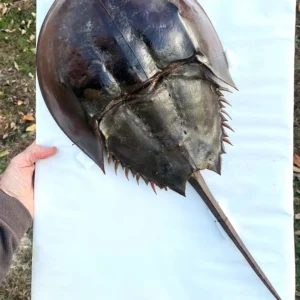
Horseshoe Crab (HSC-1)
Notes specific to this specimen: This is one of the LARGEST specimens ever found. The largest Atlantic horseshoe crab ever documented is 25″. This one has a deep mahogany color. Beautiful shiney shell with no damage. Like all our horseshoe crab specimens this one does not have gills or undersides (Birds and other scavengers feed upon the soft undersides long before we get there.) What you will receive is just the carapace you see here. It is wired to the cardboard backing and is easily removed. The specimen can be mounted directly on a wall or in a shadowbox.
Size including telson (tail): 12″ x 24″ x 5″h
Name / Species: Limulus polyphemus
Age: Recent
Unit:
Site: Gulf of Mexico, Florida
Collected: 2025
Collected by: Jon and JulieDocumentation: This authentic specimen comes with a Certificate of Authenticity and Origin documenting where, when, and who collected and prepared it.
-
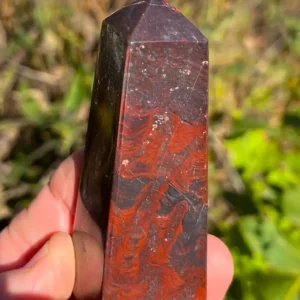 $185.00
Iron Stromatolites (MEOB3)
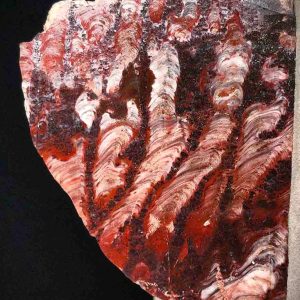
Notes specific to this specimen: You will receive an obelisk very similar to this one shown. We fashion only a limited number of obelisks out of this material because in the process we lose a lot of material. Even so, it is sometimes worth it as the cutting of obelisks creates a great 3-D view of the colonies. Here we have deep red agatization in these longitudinally cut colonies. These specimens attest to the classic origin of this material from the old Mary Ellen Mine in Biwabik, Minnesota, the type locality for the Biwabik Iron Formation. The mine shut down over 50 years ago. We find the material in the old discard piles that surround the pit.
Size: 3.25″ x 4″ tall
Name / Species: Collenia undosa
Age: Paleoproterozoic – 2.1 billion years
Unit: Biwabik Iron Formation
Site: Biwabik, Minnesota
Collected: 1992
Collected by: Jon KramerDocumentation: This authentic specimen comes with a Certificate of Authenticity and Origin documenting where, when, and who collected and prepared it.
-
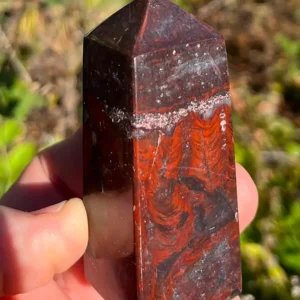 $155.00
Iron Stromatolites (MEOB2)
Notes specific to this specimen: You will receive an obelisk very similar to this one shown. We fashion only a limited number of obelisks out of this material because in the process we lose a lot of material. Even so, it is sometimes worth it as the cutting of obelisks creates a great 3-D view of the colonies. Here we have deep red agatization in these longitudinally cut colonies. These specimens attest to the classic origin of this material from the old Mary Ellen Mine in Biwabik, Minnesota, the type locality for the Biwabik Iron Formation. The mine shut down over 50 years ago. We find the material in the old discard piles that surround the pit.
Size: 2.25″ x 3″ tall
Name / Species: Collenia undosa
Age: Paleoproterozoic – 2.1 billion years
Unit: Biwabik Iron Formation
Site: Biwabik, Minnesota
Collected: 1992
Collected by: Jon KramerDocumentation: This authentic specimen comes with a Certificate of Authenticity and Origin documenting where, when, and who collected and prepared it.
-
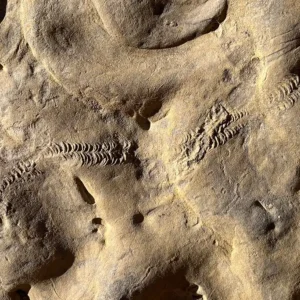 $9,600.00
Trilobite Tracks (TRX01)
Notes specific to this specimen: HOW THEY FORMED – This is the largest slab with trilobite tracks and traces ever to be found at this famous site and possibly the largest single specimen of trilobite tracks in the world. These trace fossils formed during the Mississippian Period, roughly 325 million years ago, when trilobites crawled across the soft sediment of an ancient marine seafloor. As they moved, their numerous legs scratched the soft sediment creating paired trails known as Cruziana. Look closely at the ripple patterns: You will see several places where a trilobite was crawling over a ripple crest, making clear tracks, but it then “floated” across a depression, leaving no trail at all. When it reconnected with a ripple crest on the other side, it once-again left a trail. Where a trilobite paused or burrowed shallowly into the sediment, it could leave a broader, bilobed impression called Rusophycus.
Fine sediment subsequently covered these traces, protecting them from currents and erosion. Burial and compaction gradually hardened the sediment into rock, preserving the impressions as natural casts or molds. Much later, uplift, erosion and quarrying exposed the bedding surface, revealing the intricate record of trilobite activity.
Size: 30″ x 40″ X 1.5″
Name / Species: Cruziana and Rusophycus
Age: Mississippian Period, 325 million years
Unit: Tar Springs Formation
Site: Branchville, Perry County, Indiana
Collected: 1992
Collected by: Glen Rockers, PaleoSearchDocumentation: This authentic specimen comes with a Certificate of Authenticity and Origin documenting where, when, and who collected and prepared it.
NOTE: Pickup is available for this specimen. If shipping is required, you will be charged for crating the specimen.