-
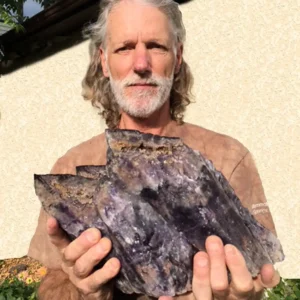
Thunder Bay Amethyst (TBA101) “The Big Kahuna”
Notes specific to this specimen: This is one of the most incredible amethyst specimens ever found anywhere. Truly gigantic crystals of deep purple. This 44-pound kahuna is unlike any other. It was discovered by us in Thunder Bay during the Pacific GeoLab (PGL) expedition there in September 2021. We’ve been displaying it ever since. These massive crystals with deep purple body have a unique final cap of smokey quartz. There are three primary and one secondary crystal termination points.
All sides of the piece are naturally shiny and show striations of the crystal growth stages. The crystal terminations are a complex of interlacing smokey quartz that is quite rare, especially in this region. Almost all large crystals of Thunder Bay amethyst have opaque red or off-white terminations. Translucent purple or smokey terminations in such gigantic crystals is extremely rare. Here, however, the primary crystals end with purple points topped by smokey caps, a doubly-rare discovery. Smokey quartz is rare in this mineralogical province, never mind the fact it is crowning these gigantic deep-purple crystals. The smokey crowns are about ½ inch in thickness overtop their host points below.
There are no alterations or reconstructions to the piece. It is completely natural. There has been no cutting, grinding, or polishing, and no treatments to enhance the colors. The specimen is authentic, and unaltered in any way. These are some of the largest amethyst crystals ever found in North America making this a one-of-a-kind museum specimen.
SHIPPING: If you cannot pick up the specimen in person, additional crating and shipping charges will apply. The piece will ship from our lab in California.
SIZE: 16″x 10″x 10″
Name / Species: Quartz, variety Amethyst
Age: Mesoproterozoic Era – 1.1 billion years
Unit: Archean Granite (unassigned formation)
Site: Diamond Willow Mine, Pearl, Ontario, Canada
Collected:
Collected by: Jon and JulieDocumentation: This authentic fossil specimen comes with a Certificate of Authenticity and Origin.
$12,800.00 -
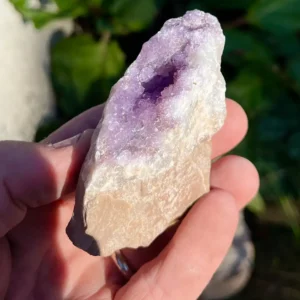
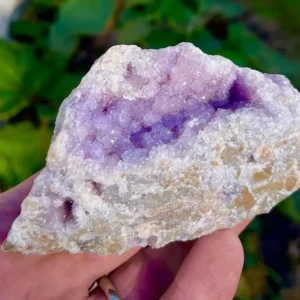
Thunder Bay Amethyst (TBA13)
Notes specific to this specimen: Warm purple crystals line this single cavity. This piece is a “stand-up” with a flat bottom allowing it to sit upright to show off the crystal cavity nicely. Rock is naturally rough all the way around.
SIZE: 3″x 2″x 3″
Name / Species: Quartz, variety Amethyst
Age: Mesoproterozoic Era – 1.1 billion years
Unit: Archean Granite (unassigned formation)
Site: Diamond Willow Mine, Pearl, Ontario, Canada
Collected: 2016
Collected by: Jon and JulieDocumentation: This authentic specimen comes with a Certificate of Authenticity and Origin.
$56.00Thunder Bay Amethyst (TBA13)
$56.00 -
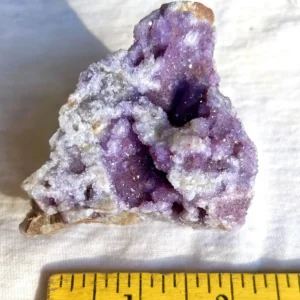
Thunder Bay Amethyst (TBA12)
Notes specific to this specimen: Warm purple crystals line the cavities in this specimen. Nice collection of complex cavities intersecting in this piece. This is a “stand-up” with a cut flat bottom allowing it to sit upright to show off the crystal cavity nicely. Rock is naturally rough all the way around.
SIZE: 3″x 3″x 2″
Name / Species: Quartz, variety Amethyst
Age: Mesoproterozoic Era – 1.1 billion years
Unit: Archean Granite (unassigned formation)
Site: Diamond Willow Mine, Pearl, Ontario, Canada
Collected: 2016
Collected by: Jon and JulieDocumentation: This authentic specimen comes with a Certificate of Authenticity and Origin.
$82.00Thunder Bay Amethyst (TBA12)
$82.00 -
Thunder Bay Amethyst (TBA11)
Notes specific to this specimen: Warm purple crystals line the cavities in this specimen. This piece is a “stand-up” with a cut flat bottom, allowing it to sit upright to show off the crystal cavity nicely. Rock is naturally rough all the way around.
SIZE: 4″x 3″x 2″
Name / Species: Quartz, variety Amethyst
Age: Mesoproterozoic Era – 1.1 billion years
Unit: Archean Granite (unassigned formation)
Site: Diamond Willow Mine, Pearl, Ontario, Canada
Collected: 2016
Collected by: Jon and JulieDocumentation: This authentic specimen comes with a Certificate of Authenticity and Origin.
$84.00Thunder Bay Amethyst (TBA11)
$84.00 -
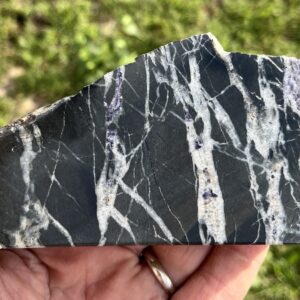
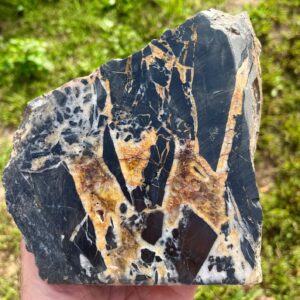
North American Rift (RIFT7)
Notes specific to this specimen: Beautiful white quartz infills the fractures of jet-black Rove Formation, with an edge vein of purple fluorite. Cut front face is polished while the back is natural but just as impressive. This specimen is a “stand-up” with a cut flat bottom allowing it to sit upright to show off the display face. Back is naturally rough.
SIZE: 5″ x 6″ x 2″
Minerals: White Quartz, Citrine, Fluorite
Age: Mesoproterozoic Era – 1.1 billion years
Unit: Rove Formation
Site: Cerdito Prospect, Thunder Bay, Ontario, Canada
Collected: 2025
By: Jon & JulieDocumentation: This authentic fossil specimen comes with a Certificate of Authenticity and Origin.
$625.00North American Rift (RIFT7)
$625.00 -
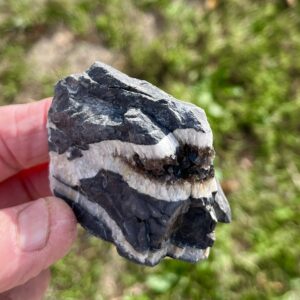
North American Rift (RIFT6)
Notes specific to this specimen: A very dynamic piece. Beautiful snow-white quartz veins with a unique deep Smoky Quartz crystal vug in one of the complex fractures of jet-black Rove Formation. Never seen anything like it. Usually when the veins have crystals they are simply terminations of the predominant mineral filling the fracture. But not in this case! This piece is 100% natural with no cuts or polishings.
SIZE: 2″ x 3″ x 1.5″
Minerals: White Quartz, Citrine, Fluorite
Age: Mesoproterozoic Era – 1.1 billion years
Unit: Rove Formation
Site: Cerdito Prospect, Thunder Bay, Ontario, Canada
Collected: 2025
By: Jon & JulieDocumentation: This authentic fossil specimen comes with a Certificate of Authenticity and Origin.
$85.00North American Rift (RIFT6)
$85.00 -
North American Rift (RIFT5)
Notes specific to this specimen: Incredible find! You can just about feel the rock ripping apart – a very dynamic piece. One of the best we’ve seen. Beautiful citrine and smoky quartz infilling in these graphic fractures of jet-black Rove Formation. Cut front face is polished. This specimen is a “stand-up” with a cut flat bottom allowing it to sit upright to show off the display face. Back is naturally rough.
SIZE: 5″x 6″x 2″
Minerals: White Quartz, Citrine, Fluorite
Age: Mesoproterozoic Era – 1.1 billion years
Unit: Rove Formation
Site: Cerdito Prospect, Thunder Bay, Ontario, Canada
Collected: 2025
By: Jon & JulieDocumentation: This authentic fossil specimen comes with a Certificate of Authenticity and Origin.
$1,425.00North American Rift (RIFT5)
$1,425.00 -
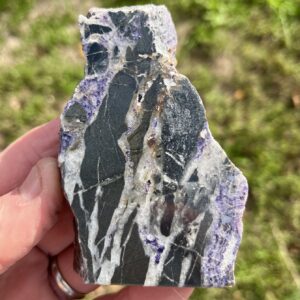
North American Rift (RIFT4)
Notes specific to this specimen: AWhite quartz infills the fractures of jet-black Rove Formation, framed in veins of purple fluorite. Cut front face is polished while the back is natural but just as impressive. This specimen is a “stand-up” with a cut flat bottom allowing it to sit upright to show off the display face. Back is naturally rough.
SIZE: 2″x 2″x 4″
Minerals: White Quartz, Citrine, Fluorite
Age: Mesoproterozoic Era – 1.1 billion years
Unit: Rove Formation
Site: Cerdito Prospect, Thunder Bay, Ontario, Canada
Collected: 2022
By: Jon & JulieDocumentation: This authentic fossil specimen comes with a Certificate of Authenticity and Origin.
$185.00North American Rift (RIFT4)
$185.00 -
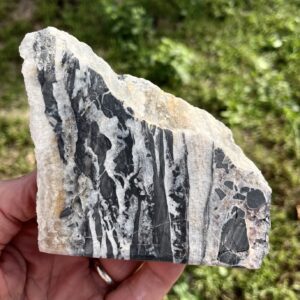
North American Rift (RIFT3)
Notes specific to this specimen: Abundance of healed fractures makes this piece a beautiful zebra-striped pattern. Stark white quartz and a faint amethyst infills the fractures of jet-black Rove Formation. Cut front face is polished while the back is natural but just as impressive. This specimen is a “stand-up” with a cut flat bottom allowing it to sit upright to show off the display face. Back is naturally rough.
SIZE: 4″x 4″x 1.5″
Minerals: White Quartz, Citrine, Fluorite
Age: Mesoproterozoic Era – 1.1 billion years
Unit: Rove Formation
Site: Cerdito Prospect, Thunder Bay, Ontario, Canada
Collected: 2022
By: Jon & JulieDocumentation: This authentic fossil specimen comes with a Certificate of Authenticity and Origin.
$265.00North American Rift (RIFT3)
$265.00 -
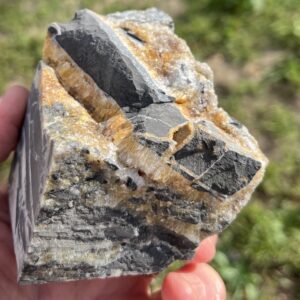
North American Rift (RIFT2)
Notes specific to this specimen: This is a very 3-D piece with front and bottom sawn and smooth, while the rest is natural rough. Beautiful citrine and smoky quartz infilling the fractures of jet-black Rove Formation. Some small crystal-lined cavities. Cut front face has a smooth satin finish. This specimen is a “stand-up” with a cut flat bottom allowing it to sit upright to show off the display face. Back is naturally rough.
SIZE: 3″x 3″x 2″
Minerals: White Quartz, Citrine, Fluorite
Age: Mesoproterozoic Era – 1.1 billion years
Unit: Rove Formation
Site: Cerdito Prospect, Thunder Bay, Ontario, Canada
Collected: 2022
By: Jon & JulieDocumentation: This authentic fossil specimen comes with a Certificate of Authenticity and Origin.
$165.00North American Rift (RIFT2)
$165.00 -
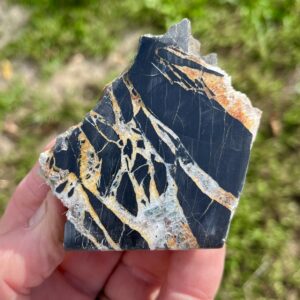
North American Rift (RIFT1)
Notes specific to this specimen: Great jagged healed fractures! Beautiful white quartz and citrine infilling mixed with a hint of green fluorite in the fractures of jet-black Rove Formation. Cut front face has a nice smooth satin finish. This specimen is a “stand-up” with a cut flat bottom, allowing it to sit upright to show off the display face. Back is naturally rough.
SIZE: 3″x 3″x 2″
Minerals: White Quartz, Citrine, Fluorite
Age: Mesoproterozoic Era – 1.1 billion years
Unit: Rove Formation
Site: Cerdito Prospect, Thunder Bay, Ontario, Canada
Collected: 2025
By: Jon & JulieDocumentation: This authentic fossil specimen comes with a Certificate of Authenticity and Origin.
$185.00North American Rift (RIFT1)
$185.00 -
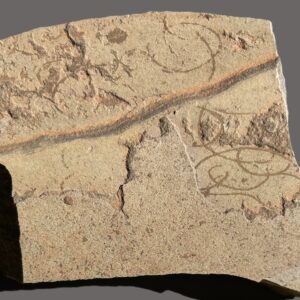
Grypania Spiralis (GRY2)
Notes specific to this specimen: Nice cabinet specimen showing several nice segments of Grypania with the classic curving arc formed by this species. Some segments show great examples of what’s been described as “desiccation” of the outer sheath along its length. This results in impingement of the sheath between individual cells, giving it a “bumpy” appearance. The desiccated segments are very rare.
SIZE: 4″ x 5″ x 0.75″
NAME: Grypania spiralis
AGE: Paleoproterozoic Era / 2.1 billion years
UNIT: Negaunee Iron Formation
SITE: Empire Mine, Palmer, Michigan$6,500.00Grypania Spiralis (GRY2)
$6,500.00
Shop Our Catalog
- Browse All Products
- Agatized Algae
- Agatized Coral
- Banded Iron Formation
- Biwabik Iron Stromatolites
- Cerdito Prospect Rift Crystals
- Dinosaur Bones
- Exceptional Museum Specimens
- Fossil Crabs
- Fossil Echinoids
- Fossil Fern
- Fossil Fish
- Grypania Spiralis
- Gunflint Chert
- Gypsum Selenite
- Biwabik Iron Stromatolites
- Kettleman Hills Fossils
- Kona Dolomite
- Minnesota Thomsonite
- North American Rift
- Rucks Pit
- Specularite
- Sudbury Impactite
- Thunder Bay Amethyst
- Trilobites
- Volcanic Bombs