-
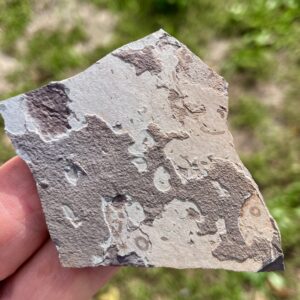
Grypania Spiralis (GRY9)
Notes specific to this specimen: Nice slab showing several clear segments of Grypania, a couple with the classic full circles and others with curving arc formed by this species. A couple of the segments – like the circle in the lower middle – show examples of what’s been described as “desiccation” of the outer sheath along its length. This results in impingement of the sheath between individual cells, giving it a “bumpy” appearance. The desiccated segments are very rare.
SIZE: 3″ x 3″
NAME: Grypania spiralis
AGE: Paleoproterozoic Era / 2.1 billion years
UNIT: Negaunee Iron Formation
SITE: Empire Mine, Palmer, Michigan$2,600.00Grypania Spiralis (GRY9)
$2,600.00 -
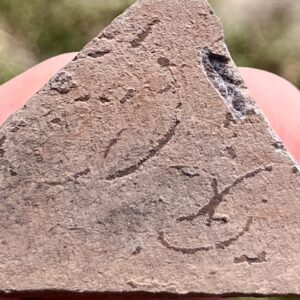
Grypania Spiralis (GRY8)
Notes specific to this specimen: Nice slab showing several clear segments of Grypania, a couple with the classic full circles and others with curving arc formed by this species. A couple of the segments – like the circle in the lower middle – show examples of what’s been described as “desiccation” of the outer sheath along its length. This results in impingement of the sheath between individual cells, giving it a “bumpy” appearance. The desiccated segments are very rare.
SIZE: 1.5″ x 2″
NAME: Grypania spiralis
AGE: Paleoproterozoic Era / 2.1 billion years
UNIT: Negaunee Iron Formation
SITE: Empire Mine, Palmer, Michigan$950.00Grypania Spiralis (GRY8)
$950.00 -
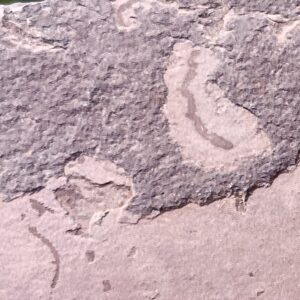
Grypania Spiralis (GRY7)
Notes specific to this specimen: This piece shows clear segments of Grypania, a couple with the classic curving arc formed by this species. The most notable, however, is the clear “squiggly” segment in the top left. It is a perfect example of what’s been described as “desiccation” of the outer sheath along its length, resulting in impingement of the sheath between individual cells. It doesn’t get any more graphic than this!
SIZE: 2″ x 3″
NAME: Grypania spiralis
AGE: Paleoproterozoic Era / 2.1 billion years
UNIT: Negaunee Iron Formation
SITE: Empire Mine, Palmer, Michigan$1,800.00Grypania Spiralis (GRY7)
$1,800.00 -
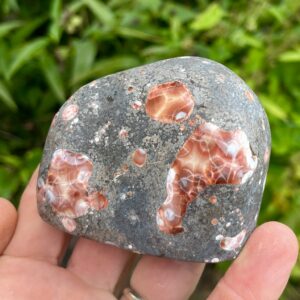
Minnesota Thomsonite (MNT002)
Notes specific to this specimen: Rare dense accumulation of nodules in matrix, from what was known as a “Bonanza” zone in the “Pink Pit”. Colors varied from pit to pit in the mine. The Pink Pit was the largest and most accessible pit and was right in the center of the Thomsonite Mine, adjacent to the parking area. On rare occasions we would mine into a “Bonanza” which was a zone especially dense with nodules. This piece has a sawn flat bottom with smoothed and polished front and natural rough back. It has three very bright, large nodules exposed with high polish on the front face. They could be removed and cut for jewelry.
Size: 3″ x 4″ x 1.5″
Name / Species: Thomsonite
Age: Mesoproterozoic Era, 1.1 billion years
Unit: Terrace Point Basalt
Site: Alley Agate Shop Thomsonite Mine Cook County, Grand Marais, MInnesota
Collected:
Collected by: Jon KramerDocumentation: This authentic fossil specimen comes with a Certificate of Authenticity and Origin. In addition, an attractive and informative display card accompanies the specimen.
$485.00Minnesota Thomsonite (MNT002)
$485.00 -
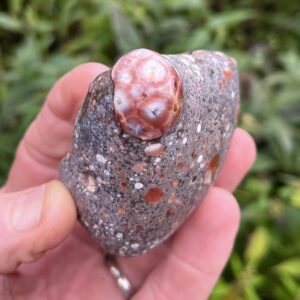
Minnesota Thomsonite (MNT001)
Notes specific to this specimen: Rare dense accumulation of nodules in matrix, from what was known as a “Bonanza” zone in the “Pink Pit”. Colors varied from pit to pit in the mine. The Pink Pit was the largest and most accessible pit and was right in the center of the Thomsonite Mine, adjacent to the parking area. On rare occasions we would mine into a “Bonanza” which was a zone especially dense with nodules. This piece has a sawn flat bottom with smoothed and polished front and natural rough back. It has a very bright, large single nodule on the top, sticking out of the matrix with a brilliant polish. It could be removed and cut for jewelry.
Size: 2.5″ x 3″ x 1.5″
Name / Species: Thomsonite
Age: Mesoproterozoic Era, 1.1 billion years
Unit: Terrace Point Basalt
Site: Alley Agate Shop Thomsonite Mine Cook County, Grand Marais, MInnesota
Collected: 1981
Collected by: Jon KramerDocumentation: This authentic fossil specimen comes with a Certificate of Authenticity and Origin. In addition, an attractive and informative display card accompanies the specimen.
$285.00Minnesota Thomsonite (MNT001)
$285.00 -
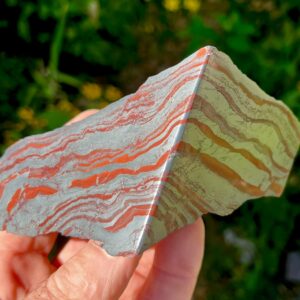
Banded Iron Formation (BIF12)
Notes specific to this specimen: Super nice double face sliced at 90 degrees apart to show the layering from different angles. Red jasper alternating with hematite silver banding. Two sides with brilliant polishing, the rest is naturally rough. A classic specimen cut in a very unique way. From the classic BIF Type Locality of Jasper Knob in Ishpeming, MIchigan. Nothing else like it!
SIZE: 6″x 4″x 3″
MINERALS: Jasper & Hematite
AGE: Paleoproterozoic – 2.1 billion years
UNIT: Negaunee Iron Formation
SITE: Ishpeming, Michigan
COLLECTED: 2025
BY: Julie & JonDocumentation: This authentic fossil specimen comes with a Certificate of Authenticity and Origin. In addition, an attractive and informative display card accompanies the specimen.
$545.00Banded Iron Formation (BIF12)
$545.00 -
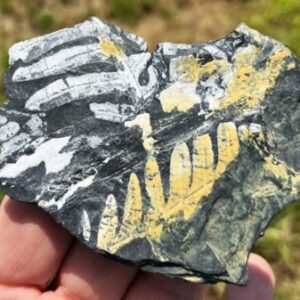
St Clair Flora – rare preservation (F13)
Notes specific to this specimen: Two sided specimen – front and back both have ferns showing clearly.
NAME: Alethopteris
AGE: Carboniferous Period – 305 million years
UNIT: Llewellyn Formation
SITE: Schuylkill County, PennsylvaniaSize: 3.5 x 2.5″
Documentation: This authentic fossil specimen comes with a Certificate of Authenticity and Origin. In addition, an attractive and informative display card accompanies the specimen.
$30.00 -
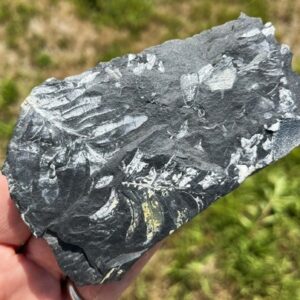
St Clair Flora – rare preservation (F12)
Notes specific to this specimen: Two sided specimen – front and back are equally compelling with a dominant single fern on each side.
NAME: Alethopteris
AGE: Carboniferous Period – 305 million years
UNIT: Llewellyn Formation
SITE: Schuylkill County, PennsylvaniaSize: 5 x 2.5″
Documentation: This authentic fossil specimen comes with a Certificate of Authenticity and Origin. In addition, an attractive and informative display card accompanies the specimen.
$38.00 -
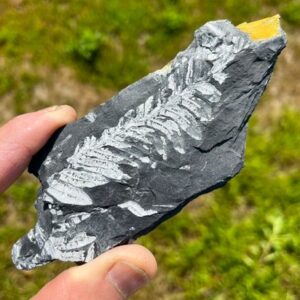
St Clair Flora – rare preservation (F11)
Notes specific to this specimen:Two sided specimen – front and back are equally compelling with a dominant single fern on each side.
NAME: Alethopteris
AGE: Carboniferous Period – 305 million years
UNIT: Llewellyn Formation
SITE: Schuylkill County, PennsylvaniaSize: 5 x 2″
Documentation: This authentic fossil specimen comes with a Certificate of Authenticity and Origin. In addition, an attractive and informative display card accompanies the specimen.
$56.00 -
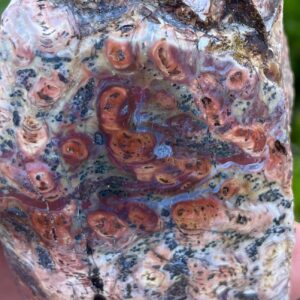
Gunflint Chert (GIS21)
Notes specific to this specimen: One of the most colorful pieces so far – incredible piece! Multiple very clear stromatolite colonies throughout the specimen. All the more impressive because it’s from the world-famous Gunflint Iron Formation. This piece is from our original discovery in 2025. Beautiful deep red colonies, surrounded by pink and yellow and white with natural black halos. Unlike anything we’ve ever seen. Polished with brilliant shine on front face only. Back and edges are naturally rough.
SIZE: 5″ X 2.5″ X 2.5″
Name: Collenia sp. (possible new species)
Age: Anamikean / Paleoproterozoic – 1.88 billion years
Unit: Gunflint Iron Formation
Site: Ontario, Canada
Date: 2025Documentation: This authentic fossil specimen comes with a Certificate of Authenticity and Origin. In addition, an attractive and informative display card accompanies the specimen.
$885.00Gunflint Chert (GIS21)
$885.00 -
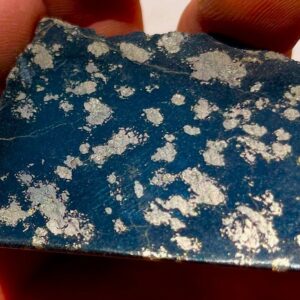
Sudbury Impactite (SUD15)
Notes specific to this specimen: Corner stand-up piece with gloss polish on the two sawn faces. Natural rough on back. Nice splashes of both copper and nickel crystallizations in this piece with very unusual empty patch on one face. Super nice little display piece
SIZE: 1.5″ X 1.5″ X 2.5″
NAME: Sudbury Impactite
MINERALS: Pentlandite (nickel) & Chalcopyrite (copper)
AGE: Paleoproterozoic Era – 1.85 billion years
UNIT: Sudbury Impact Complex
SITE: Sudbury, Ontario, CanadaDocumentation: This specimen comes with a Certificate of Authenticity and Origin. In addition, an informative display card accompanies the specimen.
$195.00Sudbury Impactite (SUD15)
$195.00 -
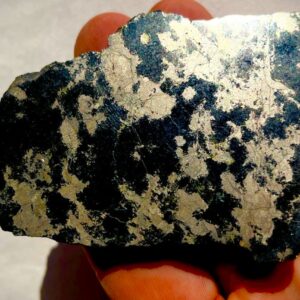
Sudbury Impactite (SUD14)
Notes specific to this specimen: Cut slab with nice splashes of both copper and nickel crystallizations in this piece. Front gloss polished, back sawn.
SIZE: 2″ X 3″
NAME: Sudbury Impactite
MINERALS: Pentlandite (nickel) & Chalcopyrite (copper)
AGE: Paleoproterozoic Era – 1.85 billion years
UNIT: Sudbury Impact Complex
SITE: Sudbury, Ontario, CanadaDocumentation: This specimen comes with a Certificate of Authenticity and Origin. In addition, an informative display card accompanies the specimen.
$165.00Sudbury Impactite (SUD14)
$165.00
Shop Our Catalog
- Browse All Products
- Agatized Algae
- Agatized Coral
- Banded Iron Formation
- Biwabik Iron Stromatolites
- Cerdito Prospect Rift Crystals
- Dinosaur Bones
- Exceptional Museum Specimens
- Fossil Crabs
- Fossil Echinoids
- Fossil Fern
- Fossil Fish
- Grypania Spiralis
- Gunflint Chert
- Gypsum Selenite
- Biwabik Iron Stromatolites
- Kettleman Hills Fossils
- Kona Dolomite
- Minnesota Thomsonite
- North American Rift
- Rucks Pit
- Specularite
- Sudbury Impactite
- Thunder Bay Amethyst
- Trilobites
- Volcanic Bombs